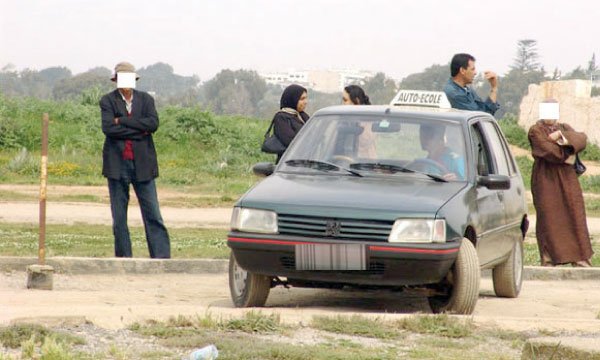
It is well known that candidates for a driving licence deal with two instructors, one for learning the Highway Code and the other for practical driving. While the work of the first is relatively easy (except with illiterate people, for whom it is necessary to deploy treasures of patience), it is not the same for the second: in the field, the driving instructor must in principle spend half an hour per session with each candidate. In reality, "he only devotes 15 to 20 minutes to them," testifies a professional instructor. It is difficult to do better when one knows that he is often forced to take 25 to 30 people in the same day. "The clients suffer from it. They don't really learn to drive, but just enough to pass the exam": therefore, parking, U-turns, entering a garage, and reversing, mainly. The reason invoked is that bosses ask instructors to speed things up as much as possible to get rid of the client as quickly as possible, who pays a package ranging from 1,500 DH for light cars to 3,500 DH for heavy goods vehicles and public transport, "paperwork fees not included," according to driving schools. "We would like to do our job properly, but the bosses ask us to dispatch each client in ten days!" defends an instructor.
Some driving school owners would also like to save as much as possible on diesel. According to the instructors we interviewed, lessons are generally given without an appointment. It is the "first come, first served" rule. Even when candidates show up at late hours or at lunchtime, instructors are forced to provide the lesson. The golden rule of the bosses is to never send anyone away empty-handed.
To be a driving school instructor, one must have a professional aptitude certificate issued by the Ministry of Transport. Conditions to be met: possess a licence for several categories (motorcycles, tourism, buses, trucks, and trailers), a diploma in mechanics, and finally pass a series of exams (code, driving, and mechanics). No specific level of education is required, which means that some driving school instructors can barely read or write. Previously, it was not even necessary to have training in mechanics. The first instructors therefore do not have this diploma. But everyone should theoretically have the instructor card, a true authorisation to practice. Unfortunately, not everyone has it. "Some barely have the tourism driving licence. And because they don't have the right to practice, they are underpaid, which harms real instructors." According to the testimonies collected, this situation is due to the fact that there is very little control. Starting with that of the Ministry of Transport. "And even when there is one, sometimes a tip is enough for everything to be back in order." Fake instructors therefore compete with real ones and some bosses use this as an argument to get the latter to accept miserable wages. Instructors, paid by the week, earn about 350 DH. The majority receive between 1,500 and 1,750 DH per month, even after many years of seniority. Those who reach or exceed 2,000 DH are very rare. Of course, everyone says they are underpaid and some seem truly desperate. The worst part is also the cars made available to them, which are often in a pitiful state. Some look more like carcasses than work tools. Rare are the instructors (and students too!) who have the chance to have a new car. In France, driving school bosses renew their car fleets every four or five years. Instructors also complain about not having workspaces. Generally, they squat in a street near their driving school that is as little frequented as possible. The time devoted to actual driving is really tiny. This explains why many motorists are not ready to face traffic jams, even after obtaining the licence. Instructors are forced to be very careful to prevent students from having accidents.
New specifications for driving schools
These specifications will determine the financial and technical capacities that the driving school must have, the means and methods of operating the establishment, the skills required to provide driving instruction, as well as the methods, programmes, and tools for driving instruction.