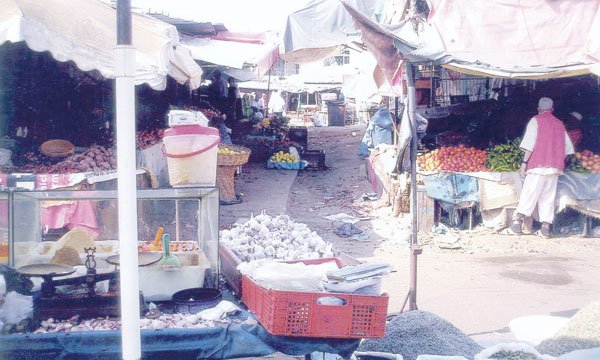
The various markets of Mohammedia generate many jobs and contribute positively to its development. Nevertheless, some markets, particularly the old ones, which are very busy, are neither structured nor equipped with adequate facilities to meet the requirements of the inhabitants. The pseudo-market on Rue La Fontaine, erected along one of the perimeter walls of the Kasbah, is a black spot that illustrates the negligence and lack of rigorous controls on the products exposed for sale. Anarchy and disorder reign on the spot, waste litters the ground, and illegal parking of cars and trucks creates nightmarish traffic jams. All this generates various types of pollution: environmental, noise, and visual.
Some merchants have appropriated the pavements and roads without worrying about the laws regulating the sector. Regarding hygiene, we notice that the laxity of the authorities encourages certain practices that harm the health of citizens. Vegetables, fruits, fish, and other foodstuffs are exposed all day long without concern
for the negative repercussions on the health of consumers. Fish is sold in some points without any respect for the slightest basic standards. The services concerned, when contacted, did not wish to comment on the issue and did not deign to disclose any assessment of the control operations and sanctions taken against offenders.
If controls are indeed carried out during the holy month of Ramadan, this type of market is forgotten the rest of the year, abandoned to merchants who dictate their own law. The anarchy at this market gives a less than flattering image of a city that strives to promote coherent and integrated management of its urban space. "Our ordeal," assures a regular at this market, "has lasted for a long time without the slightest effort being made to change things. Not to dwell too much on the many problems posed by this market, it should be emphasized that the only solution lies in its transfer to a more suitable place.
The old wholesale market behind the court, closed for a long time, offers all the conditions to move all the merchants from Rue La Fontaine."
Another black spot appears on the map: the municipal market, called "joutia", located in the heart
of El Alia and surrounded by many houses. It covers more than 3.2 hectares. Operational since 1989, it is considered the largest market in the city with 432 built commercial premises, 710 unbuilt spaces, and 44 spaces for grain merchants.
Despite its importance, the joutia, the primary place of trade, has never been redeveloped or restructured. This market is undermined by various ills, notably poor management, a lack of organization, and a lack of control, which are at the root of serious problems of hygiene, safety, and mobility inside. The number of peddlers, spaces, and merchants has quadrupled in a short period, creating a situation of unprecedented disorder.
The markets of Rue de La Fontaine and El Alia certainly play a role in the city's economic activity, but they are plagued by several dysfunctions that require restructuring and upgrading. The economic development of Mohammedia cannot take place without participatory development. n
At the El Alia market, among the most worrying obstacles is the impossibility for vehicles to access the interior of the market, which has a negative impact on the transport of goods. To do this, merchants still use three-wheelers, but also carts. Even fish and meat are transported in the same way without worrying about hygiene problems.
The most serious thing, however, concerns the areas for welders who work with acetylene and oxygen cylinders in precarious conditions without the use of panels for the protection of passers-by. In the event of an accident or fire, it would be difficult to get help. Indeed, Civil Protection vehicles and ambulances cannot circulate inside the market.