FrançaisEnglishالعربيةDeutschEspañolNederlandsItaliano中文

Your cart is empty

Adventure awaits!

About M'hamid El Ghizlane

M'hamid El Ghizlane is a Moroccan commune in the province of Zagora, in the Drâa-Tafilalet region (formerly Souss-Massa-Drâa).

News in M'hamid El Ghizlane

Follow the latest news, projects, and official announcements from your commune.

Festival 18 Feb 2016 13 min read

All nomads! Born free and staying that way...

Every year, the month of March signals the return of Tuareg guitars and other world music to the stage of the International Nomads Festival. Since its creation in 2004, the event has become a landmark in Morocco and internationally. It is a precious meeting with lifestyles adapted to a fragile environment, with a culture and customs threatened with disappearance. It testifies to the attachment of an entire population to its roots, to its history, to a future that it wishes to be better for every child who has the chance to grow up in peace in this magnificent Draa valley at the gates of the Moroccan Sahara, but also everywhere else on the planet.
All nomads! Born free and staying that way...

The Festival is our common image and a tool shared by all for the promotion of our heritage.

Noureddine Bougrab, creator and director of the festival


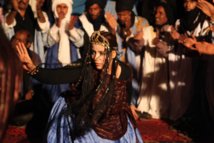
Women of M'Hamid at the Festival, 2011 Edition © S. Coulaud

Women of M'Hamid el Ghizlane at the Festival, 2011 Edition © S.Coulaud


Emblematic for its geographical location and its prestigious past, M'hamid el Ghizlane, the last oasis of the Draa Valley, is preparing to welcome festival-goers from very far away from 18 to 20 March to experience, among and with the inhabitants, three days of celebration with the scent of adventure.


Choosing to experience a Moroccan festival in the desert in M'hamid (March), Merzouga (April), or Tighmert (end of July) means getting back on one's feet in a traditional world foreign to our ways of thinking: subtle in the art of welcome and exchange, astonishing in what it gives off that is powerful and irresistible.


It is approaching codes and ways of being without necessarily understanding them. No panic! Let go, let rest, put down... Wait, relax, until the moment when the body and mind, freed from tensions, stress, and the time that presses, can finally abandon themselves to an invigorating alchemy whose fragile balance forces everyone—man, woman, child—to keep a low profile in the face of adversity without losing any of their pride, their joy of living, their thirst for sharing.


And what if the urgency was precisely to learn to re-open the door to our own thirst for freedom, simplicity, and elsewhere?


A beautiful experience that I was very happy to share with a motivated and friendly team; an original, improvised, warm, and so human adventure! I love it.

Dominique Micollier, volunteer, from the South of France to the South of Morocco, March 2015


Dominique, the queen of backstage, is a regular at festivals. Her thing is decor and artists comfortable in their flip-flops!

Dominique, the queen of backstage, is a regular at festivals. Her thing? Decorating with next to nothing, a smile for everyone: artists, volunteers, technicians


In this atmosphere of oasis and desert, between effervescence and nonchalance, candour and intelligence, wisdom and excess, everything invites you to leave behind habits and other servitudes. You will be very surprised to no longer be on your guard when the very idea of trust seems to have soon deserted our post-modern societies. Did you know that in the time of the caravans, there was a place known to all the Bedouins south of M'hamid, the Sacred Oasis, safer than a bank and better guarded by no one than by a thousand soldiers?


For now, at the Souk, in the Kasbahs, at the end of the palm grove, in the surrounding bivouacs, and perhaps even at the summit of the Zahar facing the cameras of the ultra-secure border where a few dromedaries still get lost despite the barriers, the subject of conversation is easily found. Everyone is active.


At the helm since 2004, the date of the creation of the Nomads of the World association and the very first edition of the International Nomads Festival, Noureddine Bougrab is the one who can best tell us about this crazy project, carried by a 100% volunteer local team. In less than ten years, the festival has managed to establish itself as a reference, despite the difficulties inherent in the remoteness and the absence of operational cultural facilities in this Saharan region.


This son of the desert has realised his hope: to share his culture beyond borders and make his village, M'hamid el Ghislane, a crossroads of nomadic cultures

This son of the desert embodies hope and faith in youth. His dream? To share his culture beyond borders and make his village a crossroads of nomadic cultures. In 2004, the dream became reality and since then... Noureddine always sees further. He paves the way!


In this destitution specific to nomadic lifestyles, no need for artifice, for overbidding. Everyone makes do with what they have, with who they are, with friends who also move abroad. The success of the initiative participates and contributes to keeping alive the magic of a universal sympathy, this dream of freedom and adventure that maintains in the collective imagination the vivid image of the time of the caravans on all continents.


The blue men and their incredible destiny continue to make the whole world dream. For Adil Belaguid, a young trilingual graduate looking for a job in tourism, being a presenter for the festival is more than an honour, it's a matter of the heart. “Anything for M'hamid is dear to my heart. Feeling nomadic is feeling free to create.”


Rare are the young people in M'hamid who have the chance to go to university, but all have been going to the festival since 2004, that's something!

Rare are the young people in the village who went to university like Adil, but all have been going to the festival since 2004, a beautiful fight! Mohamed, on the right in the image, will not say the opposite. He chose the life of an artist, as free and happy on a stage as in the desert.


Interview with Noureddine Bougrab


What better than culture to promote development?


PB: When in 2004 you took up the challenge of creating a festival in your village, how was this initiative received?


NB: The initiative was very well received by everyone, particularly by the local population whose heritage is honoured there. They liked the idea that it was one of their own, a son of the desert, who had this desire to create the first cultural event of M'hamid and even of the entire Draa region. What better than culture to promote development?Guedra and dancer


PB: Many partners support you in this adventure. How did you manage to get them to adhere to this cause which is the transmission of your traditions, your customs, to this desire to share this heritage beyond borders?


NB: At that time, defending heritage was a challenge in our country. However, the tangible and intangible heritage of the nomads was in perdition. For me, it was urgent to act to avoid all our values and traditions being lost; for that, they had to be transmitted to the young generations! In Morocco and elsewhere, not everyone knows the nomadic lifestyle. Most of those I contacted were interested in discovering more. I think I can say that I generally have good contact with people and that I inspire confidence in them. It was my determination and my patience that allowed me to convince partners of the urgency of the situation and to get them to commit to this cause. The trust granted by the first partners encouraged others to get involved. I thank them for their loyalty and their civic spirit! We did not disappoint them and we ensure that the partnerships are renewed. Thanks to this renewed trust in cooperation, the Nomads Festival has become, year after year, an unmissable event in the calendar of festivals of the Kingdom.


Nomadic hockey FW4A9479


PB: How do the inhabitants contribute to the initiative?


NB: It is especially the young people who are very involved; they are aware that such an event participates in the promotion and development of their region. Being a stakeholder in the event helps them develop their organisation and communication skills. This gives them access to new horizons. The festival is a unifying event that creates a local dynamic, at the origin of multiple new initiatives. It has become a real vector of development. And that is one of the true originalities of this festival in the desert.


PB: Would you say that the International Nomads Festival is an event whose success and international notoriety the entire population can claim today, just like your supporters in Morocco and abroad?


NB: YES, it is obvious for the majority of them as well as for all those who support us. The young people of M'hamid who assist us wherever necessary have their share in the good organisation of the event. All the groups of young musicians from M'hamid perform every year in front of their friends, families, and fans on an international stage!


la-nati-flamenco1

Nati James is a composer, singer, conductor of the Nati James Orchestra, and flamenco dancer. In M'hamid, she will present her show "Yalil Flamenca"


It is therefore logical that they feel proud and appropriate the event a little! If the women did not come, I would feel the failure of the initiative. However, they are very numerous to come and attend all the activities. The Festival is our common image, and a tool shared by all for the promotion of our heritage.


PB: Your commitment, that of the volunteers, allows offering everyone a dense and rich programme for free. What deep convictions allow you not to give in to ease to keep the primary ambition of this tribute to nomadic cultures intact over the years?


NB: These are my own roots, my culture. I am proud of it and I am very attached to it! That is why it is important in my eyes not to deviate from the original concept, to keep all its authenticity and all its meaning to this event. And even if the festival programmes one or two more "modern" groups each year, it is to satisfy the local population which is one of the first targets of my commitment, and which does not have easy access to art and culture, nor to a large offer of entertainment on site. It is thanks to our partners, local authorities, volunteers who work assiduously by our side, that this is possible.


Mari Helander and Anne Lise Johnsen Swart

Mari Helander and Anne Lise Johnsen Swart will be on stage on 18 March to share with the public the art of storytelling, poetry, and singing, among the Sami


PB: In 2016, what reasons would you like to evoke for new festival-goers to join M'hamid El Ghizlane from 18 to 20 March?


NB: The attraction of a cultural journey that rubs shoulders with the natural. The invitation to discovery, to exchange, to sharing in joy, simplicity, the generosity of the welcome, the authenticity that gives its "soul" to our festival. The festival develops edition after edition with a programme that is always renewed and of quality. The number of activities increases, making the event always more interesting.


PB: Among the proposals that appear on the programme this year, which are those that are particularly close to your heart, personally? Why?


NB: I will be happy to set up the Nomads Forum project this year, a set of workshops aimed at reflecting on solutions, at giving hope in the future of nomadism. Furthermore, concretising North-South exchanges (between artists and between festival-goers) is important in my eyes. They will be done through the participation, among others, of the Joik singers whom I wanted to invite since my first trip to the Sami in Norway, of Terakaft coming from the desert, and other artists from various horizons.


12650614_1064897896896097_1293068215_n


Giving back to my land, to my family, what they gave me that is so precious


Testimony of Adil Belaguid


A little boy who grew up in such a small village, I was trying to understand how to become a man, a good man. Finding your way in today's society when you were born in the Sahara, an immense territory that does not benefit from the same perspectives, the same assets as other regions, is not an easy thing. So the solution is to start from who I am, from my nomadic culture, to express this freedom that is mine. If I am a volunteer, it is to carry this message and share it.


It is my way of giving back to my land, M'hamid el Ghizlane, the energy that made me become the man I am. People often say that the desert is empty, they say that you can't do anything with emptiness. For me, it's quite the opposite. In the Sahara, our lifestyle forges qualities that urban societies have reduced to nothing. I have the intimate conviction that the values that are mine and those of nomads around the world have meaning. They can contribute to exchanges, they allow inventing answers, including to imagine the cities and countrysides of tomorrow.


When the festival was born, it was not just a very beautiful occasion for us, inhabitants of the village, to meet to celebrate and keep our traditions alive. I experienced it as a real opportunity to reconnect to our roots. Without meetings like this one, our roots can lose all meaning in our existences, in our ways of living the present, of thinking about the future.


For like water, wood, livestock, even sand, with which we do so many things, culture is one of the most precious resources.


The International Nomads Festival is a hymn to joy, to friendship between peoples, and to the specific contribution of our culture as it can express itself in its difference in echo to a world in perpetual evolution.


We nomads, we are the fruits of our experience, of our capacity for adaptation to all environments, even the most hostile in your eyes, when what seems so unnatural to me is to evolve in a society based on obligations, restrictions.


Being born free is a gift whose price I know. If I want to live like this, as a nomad, it is to be able to feel free. I am driven by this desire to be in my turn a conveyor of culture, like the elders who bequeathed us this identity, this pride, this spirit of independence that goes hand in hand with the awareness that we are dependent on the resources that ensure our survival, day after day. For like water, wood, livestock, even sand, with which we do so many things, culture is one of the most precious resources.


Adil hopes to join a large European university as early as September. He loves his job as a guide in the Sahara, participating in youth meetings, like in Ukraine this summer, and presenting in English the many groups that join him on stage every evening during the festival.


Thanks to Noureddine and his volunteer team for having accepted for the readers of Mondoblog to lift the veil on the backstage and the values of their beautiful festival. They offer us as a bonus and in preview the names of the artists on the bill for this 2016 edition. The concert programme is not yet online on their brand new site to be known without moderation, but it won't be long.


Thank you for sharing.


Terakaft – Afel Bocoum – La Nati – Flamenco – Sami Group, Norway Mnat Azawan, Said Senhaji, Farid Ghannam, Said Charaad, Kel Tamasheq Oued Noun, Dakat Sif Local groups of young people from M'hamid


The International Nomads Festival is an invitation to travel, to dialogue, to openness to the world. Everyone is welcome to fill up on emotions whose many reports devoted to this region have captured all the intensity.

The International Nomads Festival is an invitation to travel, to dialogue, to openness to the world. Everyone is welcome to fill up on emotions whose many reports devoted to this region have captured all the intensity.


B for Bonus


http://www.nomadsfestival.org/">http://www.nomadsfestival.org

https://www.facebook.com/nomade.monde/">https://www.facebook.com/nomade.monde

http://www.samigoldsource.com/">http://www.samigoldsource.com/


Listen
Size: