This reflection is not surprising for this peaceful locality -located near Taroudant-, from which flows a flagship Moroccan product whose reputation crosses borders.
However, although the Taliouine Label saffron has acquired global notoriety, it is certainly not safe from difficulties that are those of other agricultural sectors, notably in terms of structuring and commercialisation.
The Taliouine zone is the centre of saffron production in the Kingdom. The Souktana cooperative has been operating there for ages, an emblematic structure and showcase for the sector in terms of commercialisation of this spice, but also of improvement of production quality.
In a statement to the MAP, the general director of the cooperative, Driss Samih, does not stop enumerating the virtues and benefits of this exceptional product, while noting the main problems that hinder the development of its cultivation.
"Morocco is the only African country that produces organic saffron of superior quality and whose colouring power, between 228 and 240%, exceeds that of saffron cultivated in Iran (160%), the world's leading producer," he specified, adding that the red gold of Taliouine is distinguished by its colour, a beautiful dark red, its strong odour, and its unequalled flavour.
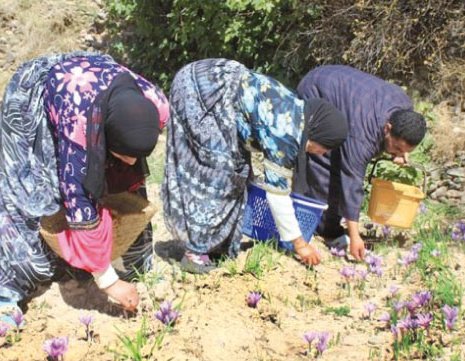
Saffron comes from the flower of the Crocus sativus, a mauve and bulbous plant belonging to the Iridaceae family. The corolla contains yellow stamens as well as three long red stigmas. Once dried, these stigmas give saffron.
Red gold needs a special soil and depends greatly on climatic hazards: it requires a hot summer between 30 and 40 and a humid and cold winter provided that the temperature is not lower than 15 .
The harvest takes place between mid-October and mid-November and is concentrated over a period of two to three hours, at daybreak, so that the stigmas are not withered by the sun. These should be picked very quickly to avoid the flowers being crushed.
The picking, daily and by hand, requires a lot of work, which is what justifies its exorbitant price.
According to the boss of "Souktana", the selling price fluctuates between 12,000 DH/KG for bulk saffron and 100,000 DH/KG for the first choice. It takes about 230,000 flowers to have a kilo of this spice, he specified.
One of the main levers of the local economy, the cultivation and commercialisation of saffron remain confronted with organisational and distribution problems, but also with fraudulent practices, although the activity still retains its authentic character.
According to Samih, saffron is one of the most adulterated food products after alcohol: The methods are diverse and varied, ranging from the use of flower stigmas similar in appearance to the weighting of the spice by the addition of an oil, which gives it a slightly sweet taste.
One should never buy saffron in powder, but in filaments (whole), he advises, with fine, long, and dark red stigmas. The odour must be strong and the stigmas must stain the fingers.
The DG of the cooperative also deplored the lack of structuring of the sector, which has become imperative for it to be competitive against Iranian saffron, as well as the absence of a price reference and a precise set of specifications for operators, in order to better value it.
A study had indeed highlighted the existence of an informal network of intermediaries and brokers, which operates as a relay between the producers of stigmas and Moroccan buyers, traders (importers-exporters), and grocers in large cities, mainly in Casablanca.
Regarding exports, Samih made it known that they are around 98% of production, the main clients being Spain, the United States of America, and France.
According to him, "the price varies between 2.3 euros/gram for bulk saffron and 10 euros/gram for packaged saffron. The packaging is adapted to the product and meets the standards of the euro zone countries".
He, on the other hand, welcomed the efforts deployed by the Ministry of Agriculture to promote Moroccan saffron and conquer new markets, through the organisation of fairs to which international operators are invited. He cited among others the International Agricultural Fair in Morocco and the Taliouine Saffron Festival, an initiative he qualified as "very interesting but partially put to good use".
Within the framework of the Green Morocco Plan, a project for the development of saffron was implemented for the benefit of Taliouine farmers in order to allow the intensification and rehabilitation of existing saffron fields as well as the extension of planted areas and the installation of a localised irrigation system.
In this regard, Samih specified that the generalisation of drippers and the subsidy of bulbs and seeds will not fail to contribute to the increase of production and productivity so that it reaches 6 to 8 kg/ha, i.e., an annual production of 10 tonnes.
The project also tends to revalue production, training, and technical assistance for beneficiaries by improving farmers' incomes and creating stable jobs.
These actions were crowned by the creation of the House of Saffron, a structure equipped with spaces dedicated to cooperatives, a laboratory, sorting rooms, and a museum of articles and products of the sector.
However, much remains to be done to bring out a real national saffron market and make the product more accessible to both national and international clients. "It is time that saffron, a quality product that is our pride and allows us to stand out from other nations, is no longer considered a luxury product and becomes accessible to all," wished Driss Samih.
MAP