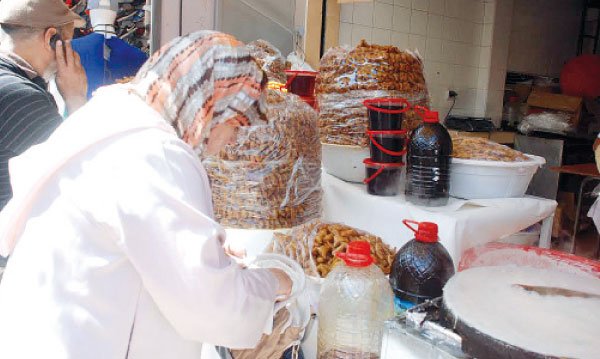
In Salé, entire families turn to casual trading during Ramadan. Young people improvise as cooks, seizing the holy month to offer various cakes popular during this period. At Bab Lakhmiss, business is booming: chebbakia, briouates, meloui, puff pastry, "Rezet el Qadi"… the list of pancakes is long, and sellers take advantage of this variety to increase their takings.
Ali, a puff pastry seller, finds his niche in this casual trade. This novice merchant, who prepares this essential ingredient for briouats, is delighted to have gained so many customers in such a short time. Indeed, a long queue, composed mainly of women, reaches the door of the neighbouring shop. Ahmed, who only recently learned this trade, believes it is a good opportunity to earn money. "Ramadan, like any symbolic holiday, has its own needs, and therefore specific trades to meet the increased demand for food products. Many young people like me seize this opportunity to at least earn some pocket money. But it is not only the young who benefit from this month. Thousands of families work hard to prepare their trade, dedicated specifically to this period, even before the start of the holy month. These are generally poor families who mobilise all their members to make this small business a success," Ahmed confides. Indeed, it is generally a well-organised business, where everyone has a specific task. Thus, the women prepare the pancakes, Moroccan cakes, or other "Ramadan chhiwates". The men, for their part, are in charge of selling the merchandise and doing the accounts. "The success of this seasonal trade depends on good organisation. You have to know that demand increases particularly in the afternoon. Consequently, the cakes must be prepared before 10 a.m.," indicates Ibrahim, one of the sellers of almond-stuffed briouats, who displays his merchandise on a small table near "Bab Labiba". Organisation is therefore the watchword for seasonal traders, but also for the managers of the various shops located in the old Medina of Rabat. These shops, which generally house other activities during the year, turn into real anthills during this holy month. Pastry shops and dairies suspend their "natural" activities to specialise in the sale of "chebakia" and "sfouf", not hesitating to recruit staff to be able to meet the increased demand for these Ramadan products. "Every family seeks to fill their table well according to their budget. People do not like to deprive themselves of good dishes during Ramadan and go as far as getting into debt to satisfy their cravings," points out Rabiaâ, a saleswoman in a pastry shop. In this sense, orders are in full swing in this pastry shop. But it is between the "Al-Âsr" prayer and the "Maghreb" prayer that the peak of demand is reached. The market then teems with street vendors, women sitting on their stools in front of their merchandise trays, or any other makeshift setup, provided it serves to display various recipes that are appetising in appearance and kind to the purse.
News 07 Jul 2014 3 min read
Ramadan, a source of income for many families