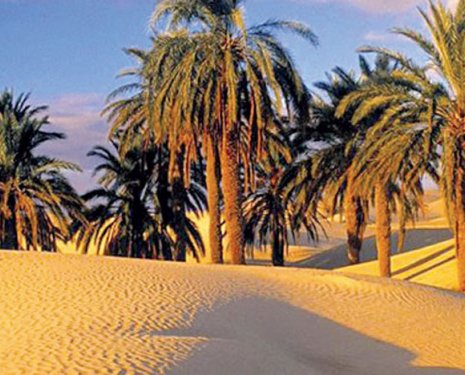
Morocco possesses a date palm heritage composed of approximately 5 million date palms, three million of which are productive. Its average production reaches, in a so-called normal year, 100,000 tonnes, with a turnover of 700 million DH, and constitutes the main source of income and the staple food for the inhabitants of the oasis regions.
In this field, Morocco is mainly competed with by Arab countries, knowing that the global potential in date palms is composed of approximately 105 million, of which 80% of production is held by the Arab world. It is estimated at 3.7 million tonnes, 70% of which is generated by Arab countries. Despite this environment which is not at all threatening, Morocco only holds 4.5% as a share of the global market.
Currently, the national palm grove covers an area of approximately 50,000 ha corresponding to approximately 4.8 million palms, which places Morocco in 7th place globally. With the objective of producing 160,000 tonnes in 2020 and 185,000 tonnes in 2030, a programme contract was signed in 2010 between the State and professionals providing for the planting of 1.4 million palms by 2014 and 3 million in 2020, the rehabilitation and reconstitution of the 48,000 ha existing and the creation of new plantations on 17,000 ha.
With more than 400,000 palms planted in 2010 and 2011, the completion rate is only 28% compared to the set objectives.
The largest share of the national harvest, namely 65,000 tonnes, comes from the Ouarzazate region. According to the ministry, "this evolution confirms the inclusion of the date palm sector in a new dynamic instilled by the Green Morocco Plan and aiming at its repositioning within the country's agricultural sector". Certainly, according to official figures, we can say that the sector is making progress and that the effort made by the various stakeholders is appreciable, but this sector can do better.
On the occasion of the third International Date Fair in Erfoud which is held from 8 to 11 November, the Minister of Agriculture and Maritime Fisheries specified that "date production stood at 110,180 tonnes during the 2011-2012 season, an increase of 10% compared to the average of the last 5 seasons".
200 exhibitors, coming from 12 Arab countries and several Asian countries, notably India, Pakistan and Afghanistan, are taking part in this edition.
This event includes a vast exhibition of the varieties of dry and soft dates produced by the three main oases where the date palm heritage is concentrated, namely Ouarzazate (41%), Tafilalet (28%) and Tata (20%), including the famous Mejhoul. The latter, known throughout the world, is distinguished by its elongated ovoid shape and by the high percentage of fruit pulp. Among the varieties exhibited are also Bouyatoub (Tata), Jihel, Bouskri, and Iklane (Draa), Assiane and Aziza Bouzid (Tafilalet), Azigzao, Boucerdoube and many others which are produced in small quantities in these regions and are directed mainly towards the domestic consumption of date growers. Stands were also reserved for the multiple products derived from dates including honey, vinegar, shampoo as well as items intended for the packaging of dates and their protection against bad weather. Equipment and machinery including machines such as drip irrigation, tractors, trucks and other installations for the processing of date palm waste were exhibited to professionals in the sector by representatives of several equipment manufacturers.
With its enormous potential, Morocco can occupy the top places in this field knowing that it is competed with by countries that nevertheless have the same potential.
News 10 Nov 2012 3 min read
Dates take over the fair