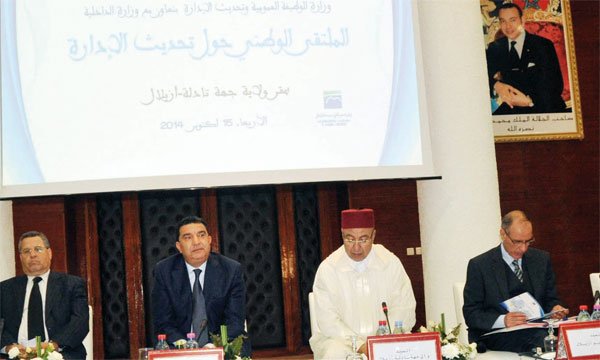
The capital of the Tadla-Azilal region, Béni-Mellal succeeds Tangier and Fès which previously hosted this event. The minister stressed that this meeting allows for sharing and exposing the main lines of the ministry's programme with the participants, and will also be an opportunity to collect their criticisms, proposals and recommendations, in order to identify local concerns and listen to those interested in order to enrich the debate and flesh out reform projects. He estimated that our country is living through historic moments under a new Constitution and with the opening of new major projects, and that the civil service cannot remain outside this evolution, because it is the essential tool for the execution of any development programme.
"Despite the significant achievements and the opening of several projects in Morocco, the Moroccan administration has not modernised. It is unacceptable today that it remains outside the reforms." These are the words and the final assessment of Mohamed Moubdii.
During his speech, the latter detailed his 2014-2016 Action Plan, which includes eighteen structuring projects for the modernisation of the administration. A roadmap that is essentially based on the global overhaul of the General Statute of the Civil Service and the regulatory texts that date back to... 1958! This plan is structured around three axes.
First of all, the valorisation of human capital, which essentially involves the global revision of the general statute of the civil service, in order to ensure the quality of public service. This revision will be done in a participatory approach through the development of a platform for the draft revision of this statute which will be presented to social partners, to the members of the Superior Council of the Civil Service (CSFP) which will be revitalised, to the network of Human Resources Directors as well as to the various parties concerned, with a view to its enrichment. The reform of pension schemes, particularly civil pensions for state and local authority civil servants, will not be left out. It will be done through the revision of criteria relating to the legal retirement age, the contribution rate, the pension calculation rate and the determination of the base salary. As for the fight against absenteeism, it will continue to constitute an emergency, through continuous control and the adoption of a text for the fight against this phenomenon which undermines the values of public service.
The second axis consists of improving the relationship between the administration and the citizen. This necessarily involves improving reception and guidance. Thus, the Plan provides for mechanisms for handling citizens' claims and complaints and the development of the administrative call and guidance centre and its pooling with existing centres. It also requires the improvement of governance, the simplification of administrative procedures and the development of E-Government. The development of the public services portal is also on the agenda. Thought was also given to the creation of local public service and local authority spaces. As for the third axis, it focuses on governance and organisation, which have already seen the launch of the National Strategy for the Fight Against Corruption and its translation into concrete actions.
The plan provides for the design of a global strategy intended to accompany advanced regionalisation and the implementation of a law on access to information.
In order to ensure more success for his action plan, the ministry has provided a set of support mechanisms through the strengthening of partnership and bilateral and multilateral cooperation, especially South-South, and provides for a roadmap and an action plan for accession to the Open Government Partnership (OGP) initiative. The plan aims to reconcile the administration with the administered and to put in place a humanised, citizen-oriented, responsible, flexible, effective, efficient and solidary administration at the service of the citizen, the investor and the company. In another register, this action plan provides for the promotion of the mobility of civil servants between administrations and local authorities and the encouragement of recruitment by contract in the public administration. The gender approach and parity in the civil service, for its part, will see the establishment of an observatory for monitoring the implementation of gender equality in the civil service. The consolidation of social welfare for civil servants will essentially pass through the development of legal texts relating to health and professional safety, occupational medicine, occupational diseases and disability pensions. The strengthening of capacities and continuous training in the civil service will continue to be the subject of particular interest. A draft law relating to the National Higher School of Administration is currently in the approval process in Parliament and the overhaul of the continuous training system has been launched.
The ministry plans to create a pilot multi-service social complex for civil servants. Appointments to high positions will be subject to an evaluation of the current system and the preparation of a draft decree amending and supplementing the decree in force. The MFPMA plans to generalise the mapping of jobs and skills to the entire public administration and plans to set up a centralised human resources database.
As a reminder, this meeting, initiated in partnership with the Ministry of the Interior, took place in the presence of the Wali Director General of Local Authorities, the Wali of the Tadla-Azilal region and Governor of the Béni-Mellal province, the governors of the provinces of Azilal and Fquih Ben Salah, parliamentarians, the president of the regional council of heads of external services, elected officials, representatives of Civil Society and other civil and military personalities and guests from various horizons.
Common threadThe principle of consultation, participation and collaboration with private actors, social partners and civil society constitutes the common thread of the implementation of the MFPMA plan. The meeting made it possible to share and expose the main lines of the ministry's programme with the participants, and was also an opportunity to collect their proposals and recommendations, in order to identify local concerns closely. The participants, notably the officials and representatives of the region and local authorities as well as officials and executives of decentralised administrations, researchers, experts, representatives of civil society and the private sector considered this meeting as an opportunity to launch the debate and discussions around the axes of the ministry's action plan, welcoming the latter's openness to the Tadla-Azilal region. Mohamed Moubdii announced the organisation of a national symposium at the end of the visit to the other regions, in order to give birth to the final and finalised version of this bold project designed in a participatory approach.
Benchmarks Number of civil servants Executives (scale 10 and above): 334,555 (64.15%). Execution (between scale 5 and 6): 94,901 (18.2%). Supervision (scales 6, 7 and 8): 92,097 (17.66%). Total: 521,553. Distribution of civil servants according to departments National Education: 54%. Interior: 16%. Health: 9%. Higher Education: 4% Economy and Finance and Justice: 3%. Agriculture, Maritime Fisheries and prisons: 2%. Equipment, transport, water and forests: 1%. Others: 5%.