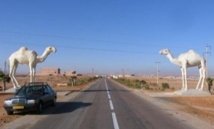
The members of the Ben Lafghir family, of the Sahrawi tribe Aït Lahcen, fraction Aït Bouguezzaten, have for more than four centuries followed the tradition of commemorating the anniversary of the death of their ancestor whose mausoleum is located at the southern exit of Tan Tan. This year, the ceremony was characterised by the presence of representatives of local authorities and elected officials, in addition to representatives of several other Sahrawi tribes and local religious authorities.
On the sidelines of the event, Libé met Ali Guermoune, president of the Association that initiated the commemorative ceremony.
Libé: Like all elected officials of the Southern provinces, you have certainly read with interest the text of the Framework Note presented to the Sovereign by the president of the CESE. What comment did it inspire in you?
Ali Guermoune: The Note presented by the president of the CESE, which concerns the development of the Southern provinces for which consultations will begin next week, delighted us because it concerns the development of these regions and constitutes a start to the application of advanced regionalisation. This note inspires the following observations: there is a preliminary diagnosis of the economic situation that was established in the absence of representatives of the populations of these provinces, whether they are trade unionists, elected officials, or representatives of the local political or economic elite. This diagnosis highlighted the major investments made by the State in these provinces, which cover all areas of development. However, from my point of view, these investments, even if they were devoted to the development of the provinces, did not concern the human element, which remains, in my opinion, the most important for global development. Regarding the projects carried out in the region, these did not benefit either the populations or the regions. These are major projects whose realisation was entrusted to large companies. But these projects do not justify the colossal sums that were devoted to them.
I am astonished when I am told that for the realisation of two public squares in Tan Tan, a budget of 2 billion centimes was released. This hurts me, because I know that for the realisation of liquid sanitation in several districts of the city, which is a priority and more expensive than public squares, we spent much less than that amount. Consequently, what must be indicated is that significant credits were released for the realisation of projects in the Saharan provinces, but the said credits were inflated and even very inflated so that companies, consulting firms, and various intermediaries could profit from them to the detriment of the inhabitants and the development of the provinces. The crucial areas whose development was fundamental were not targeted. Take the example of Tan Tan, whose economy is based on maritime fishing. Who benefits from it? A company that exploits the province's wealth does not even grant crumbs to the indigenous people. We would have liked that from the fruit of the exploitation of fishery products, a portion, at least, be invested locally to contribute to the eradication of unemployment, the high rate of which the Note highlighted in these provinces.
The president of the C.E.S.E who will be present to consult you, what would you say to him?
As president of the provincial council of Tan Tan, my intervention will be devoted to programmes that will not fail to contribute to the development of the provinces and will focus on the essential points capable of meeting the expectations of the populations and eradicating unemployment, essentially among young people. What do you want the inhabitants of the small town of Tan Tan to do with two public squares costing 2 billion centimes, when with less than that we can pave the streets of the city? It is the type of investment whose realisation is not made to benefit the inhabitants or the Southern provinces, but large companies and their armadas of consulting firms, intermediaries, and others.
The inhabitants of Tan Tan believe, and rightly so, that their city is neglected and left behind. What proposal will you make to the president of the CESE to allow the economic start of the city and put an end to the numerous protest marches that are the daily lot of its inhabitants?
The inhabitants are quite right to feel left behind and abandoned. They think that this situation is the result of negligence on the part of officials of the various departments, but they are beginning to think that this negligence is intentional. Some even blame us for the birth of the Polisario 40 years ago.
The inhabitants of Tan Tan only wish for one thing today: that an end be put to the prejudices fuelled by the neglect of this city.
News 15 Jan 2013 4 min read
Ali Guermoune: Tan Tan must benefit from a portion of the revenue generated by its wealth