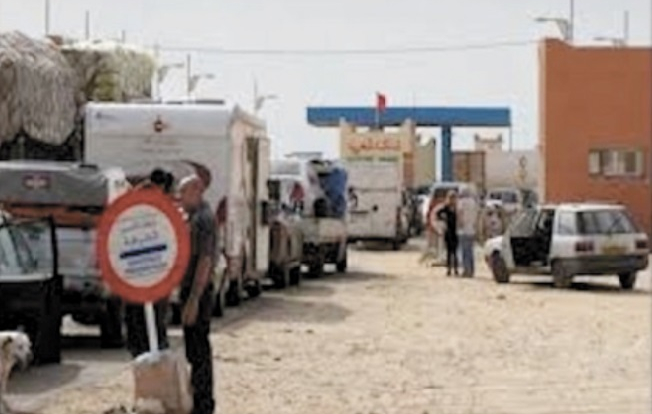
Bir Guendouz, the last commune before the Gargarate post, seat of the customs office closest to the border with Mauritania and sub-Saharan Africa, is a gateway for Morocco to its African extension.
It is in this small town of 3,000 inhabitants that importers held several meetings with customs representatives to find common ground on the customs clearance procedures for the goods they import from Mauritania and sub-Saharan Africa (Mali, Senegal, etc.)
Until 2013, the year of the arrival of the current head of the customs district in Dakhla, everything was going well, explains one of the importers who requested anonymity. He explains: "At the beginning of the 2000s, we were a few adventurers running the risk of trading with this region. We had small buses that we loaded in Casablanca and we sold the merchandise in Mauritania, Senegal or Mali. With the proceeds of these sales, we reloaded our vehicles from these countries with various goods that we sold in Dakhla and Casablanca. We continued to frequent this route by expanding our activities through the creation of companies and instead of small buses, we acquired an armada of trucks. Today, 13 companies are active on this route, with at least six to seven trucks for the smallest of these companies, supporting, directly or indirectly, 4,500 families, from Assa to Bir Guendouz. But from 2013, everything was called into question. Customs started by imposing higher and higher taxes on us; instead of the 45,000 DH we were paying per truck, we were going to move to 60,000 DH. These taxes threaten the existence of our 13 companies and, by ricochet, the income of the staff they employ and social peace".
Our source adds that these merchants are known for their patriotism and are asking for the application of measures allowing them to continue their activities and maintain the jobs created. And to ask: why not crack down on the smugglers of Sebta and Mellilia who are of no contribution to public finances? "Why attack the honest merchants that we are? We who fight against unemployment and whose contribution to public revenue varies between 2 and 3 billion centimes per month".
Our interlocutor stresses that the survival of their companies, his colleagues and himself, depends on the lives of several thousand people, including small merchants, women selling their products on the pavements of Assa, Guelmim, Smara or Laâyoune, restaurateurs who have set up along this axis to the border with Mauritania, petrol station attendants, etc. Also, they are asking for a Royal intervention, not to exempt their goods, but to lighten the taxes and procedures to which they are subjected.
The head of the Dakhla customs district indicated to us that at the beginning of these merchants' activities, the customs services at the Gargarate border post were not equipped and that the taxation model applied was the T6 bis which applies to passengers in airports and for which the value of the merchandise was lower. Thus, the flat rate of 7,000 DH that was applied to them increased as the customs were installed at this post. Today, as these services have the necessary human and material resources and following the study he carried out upon his appointment as head of this district, he suggested to the general management the application of the regulations in force throughout the territory. "It is not logical that a merchant from Casablanca can compete with his colleague from Dakhla on a product that costs him 4 times more, due to the taxes he pays", he specifies, recalling having "proceeded to a progressive application of these duties to bring them to a flat rate of 100,000 DH per truck, a rate that will see other increases".
Such are the words of the head of the customs district or CC, as he is called here. The merchants, for their part, maintain that this CC, who should be retired next February, is dealing a fatal blow to the activities of the Gargarate border post. They state that the governor confirmed to them that this zone, a gateway to Morocco, must be operational 24 hours a day and that he will do everything to encourage non-stop activities there. They also specify that they are ready to double their transport capacities, but that they cannot take this risk as long as the customs clearance conditions remain uncertain.
News 27 Nov 2014 4 min read
Arm wrestling between importers and customs at Guergarate