FrançaisEnglishالعربيةDeutschEspañolNederlandsItaliano中文

Your cart is empty

Adventure awaits!

About Agdal Riyad

Agdal Riyad is a Moroccan urban commune in the prefecture of Rabat, in the Rabat-Salé-Zemmour-Zaër region.
It has a total...

News in Agdal Riyad

Follow the latest news, projects, and official announcements from your commune.

News 08 Jul 2013 4 min read

More students and fewer teachers

The president of Mohamed V-Agdal University, Wael Benjelloun, drew up the balance sheet of his institution last Wednesday. He made a point of highlighting the problem of the imbalance between the increase in the number of students and the massive retirement of teaching staff and personnel.
More students and fewer teachers

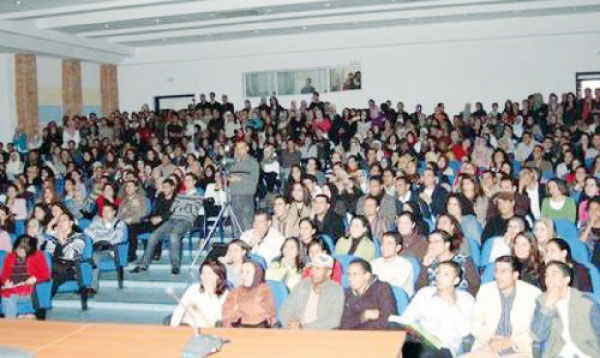
Mohammed V University of Agdal ends the 2012-2013 year with a satisfactory balance sheet. Its results are a sign of good performance at all levels of the university's intervention. This is evidenced by the data presented by Wael Benjelloun, president of the University, who met with the press last week to draw up the balance sheet of his institution. The University found itself in a movement of massification, given the growing number of those enrolled in the three faculties under the UM5A (Faculty of Sciences, Faculty of Arts and Humanities, and Faculty of Legal, Economic and Social Sciences). The number of new students enrolled in the Faculties of Law and Arts climbed from 6,763 to 10,056 students. While the total number of students enrolled in the various institutions under the University went from 27,201 to 32,693 students. The massive influx of students thus poses a real challenge to the University's officials, because at the same time, there is a departure, just as massive, of research professors into retirement: an annual average of 80 departures. "The University will thus lose nearly half of its teachers by 2020," indicated Wael Benjelloun. Of the 1,129 professors that the teaching body counted in 2013, 453 will retire by 2020. And it is the Faculty of Sciences that will be the most impacted by these departures.

The retirement of administrative and technical staff is not left out. Out of 961 positions, the UM5A lost 60 in 2012 and 69 in 2013, according to its president. The latter was as clear as could be in stating that "the University finds itself powerless in the face of this situation, especially in the absence of the creation of administrative positions for 3 successive years". In any case, the university presidency has some avenues to explore in order to manage this situation. Wael Benjelloun thus advocates the decompartmentalisation of the University as a method to face this problem, especially in a world that does not stop changing thanks to the development of technologies. "In the future, this development could play in favour of the use of distance learning and self-managed learning by the student. This will reduce the burden on the teacher," Wael Benjelloun had noted. Already, the University has launched, with the University of Montreal, a feasibility study for the use of computer-assisted experimentation (EXAO), the objective of which is to better meet the needs for practical work. At least for the next 2013-2014 academic year, Wael Benjelloun remains confident: "given the number of baccalaureate candidates in June 2013, we think we can meet the demand of the next academic year in pedagogically correct conditions," he noted, thanks to approaches adopted by the University such as listening, communication, and the involvement of students. All this has contributed, despite the massification, to the establishment of a serene climate within the institutions. As for the University's educational offer, it has seen a significant increase. This has been particularly oriented towards the job market, with the opening of 8 new professional licences and 3 specialised masters, in addition to the 7 new research masters. The launch of a licence in Chinese language and culture was also on the menu. Research is the other hobbyhorse of the University. This aspect has seen "an interesting evolution in 2012-2013, allowing the University to benefit from more visibility on the international level," according to Wael Benjelloun. Thus, the budget devoted to continuing education and mobility went from 5 million in 2012 to 8.5 million DH in 2013.

A measure that comes in addition to the implementation of an incentive programme for publication. Moreover, the number of indexed international publications went from 93 in 2009 to 287 in 2012, according to the international research database Scopus. As for the "International College and Universities", it ranked the UM5A in twentieth place in Africa and second in North Africa. And this, thanks to the visibility it has on the web.


The investment budget: another challenge to meet

Besides the challenge of staff and teaching body, the University will have to meet the budget challenge during the next year in order to meet the needs for construction and equipment of the institutions. Especially since it intends to launch, in 2014, the equipment contracts for the Tamesna site which will house a technological centre for education and research, as well as the contracts for the City of Innovation in Madinat Al Irfane and the Science Museum in the orange groves. It should be remembered that the UM5A suffered from an insufficiency of the investment budget during this year, which generated a downward revision of the objectives.

Benchmarks

-* The number of new students enrolled in the Faculties of Law and Arts went from 6,763 to 10,056 students.

-* The total number of students enrolled in the various institutions under the University went from 27,201 to 32,693.

Listen
Size: