FrançaisEnglishالعربيةDeutschEspañolNederlandsItaliano中文

Your cart is empty

Adventure awaits!

About Agdal Riyad

Agdal Riyad is a Moroccan urban commune in the prefecture of Rabat, in the Rabat-Salé-Zemmour-Zaër region.
It has a total...

News in Agdal Riyad

Follow the latest news, projects, and official announcements from your commune.

News 27 Apr 2013 5 min read

ONCF commuters exercise patience
ONCF commuters exercise patience

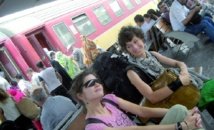
One winter morning, at the Rabat Agdal station. Naima gets out of the car after kissing her children and husband. She quickens her pace and heads towards the station. The day is grey and rainy. On the platform, dozens of travellers are waiting. Some scan the horizon in feverish anticipation, others pace back and forth, the operator having already announced a twenty-five-minute delay. Their number grows as the other schedules have been shifted. This seems to annoy our young woman to the highest degree, and yet she has been used to it for two years. Suddenly, her face lights up at the sight of an acquaintance and she heads towards her: "The day is starting well, another delay," she says to her by way of greeting. "The meeting I have today is of the utmost importance." Without a doubt, since she is a manager in a multinational. "Every day that God makes, I start the day with a knot in my stomach," she adds.

Greetings, kisses, hugs. It is in this atmosphere that three young women met. They make an appointment every day on the platform. And for good reason, they commute between Rabat and Casablanca. A whistle, finally the train is there. The travellers rush and board. With a relaxed air suggesting a long habit, the young women take possession of the space. In a compartment, Amina is waiting for them, delighted to see them arrive. You would think she is receiving them at her home. After the hubbub of the reunion, she hastens, as a good hostess, to serve her "guests". Thermos and plastic cups. "Hmm, that's coffee...", remarks Khadija while enjoying her hot drink. And to add: "Nothing to do with the instant coffee they serve us on the train. "Say rather the undrinkable dishwater," Leila calls out to her, not to mention the price. "Of course, I didn't forget to bring the pastries, go ahead, help yourselves," she says. The day starts like this in a festive atmosphere, trying as best as they can to forget the nuisances of the journey.

Barely settled, a train employee in his blue uniform, his cap screwed onto his head, comes to find them, stating: "If there are people among you who commute, please have the kindness to fill out this questionnaire." The opportunity for them to give free rein to their thoughts. Leila grabs the questionnaire and takes a quick look at it. "It's not the first time I've filled out this kind of paperwork and things are struggling to change," Leila says indignantly. Before adding: "Our litanies fall on deaf ears. We don't report our grievances and yet it would seem that there are 35,000 passengers who take the Rabat-Casablanca shuttle daily. Delays all the time, sometimes long and unexplained stops, and too bad for the travellers. When this happens at a station, everyone manages as they can. But when the stop occurs in the open countryside, you just have to arm yourself with patience." She seems quite upset because she continues on her momentum: "No later than last week when it rained, the compartments leaked. A little respect, for heaven's sake! I'm going to put all these remarks down in black and white but..." The others nod in agreement. She returns to her questionnaire, muttering all her exasperation. At the other end of the compartment, a sleepy young man, but whom the debate seems to interest, intervenes: "I completely agree with you. I had to change jobs because of my repeated delays, which my boss did not tolerate. Now that I work for myself, things are different," and adds thoughtfully: "When I was in France, I also commuted, it's much less stressful because punctuality is the rule, except in cases of force majeure, of course." A silence settles in the compartment, time for everyone to return to their questionnaire. And then Sarah, the youngest of the group, looking as if she were thinking aloud, approaches the subject from another angle: "Be sure that if there were another competitor on the rails, the Office would take the passengers' remarks more seriously in order to improve its services. Here, it holds us under its thumb." At Amina's, it's a different story. "Whatever we say and whatever reproaches we can make to the ONCF, I believe for my part that the train remains the most adequate means of transport for someone who travels every day. I know something about it since I have been commuting for 17 years. At the beginning, I took my car, but I didn't manage to hold on for long. The fatigue and stress linked to driving got the better of me. Over time, I have become a real information office. The ONCF should award me a medal for my loyalty."

Finally, the train arrives. The young women get off, almost pushing the travellers, in a hurry to get to their workplace. "I hope my cousin comes to pick me up," says Hakima, "because finding a taxi is another kettle of fish." As for Naima, she gets into the car, praying to her driver to arrive as quickly as possible.

Let's keep our fingers crossed that the TGV does better!

Listen
Size: