In Essaouira, culture is not a luxury, but rather a lever for local development that punctuates the city's current events and provides it with its aura.
But 2014 will remain etched in the annals as the year that saw the birth of concrete and practical initiatives aimed at reviving and preserving treasures of Moroccan cultural heritage.
Two actions have materialized and safeguarded, under the sky of Essaouira, jewels of Moroccan musical heritage that will thus remain etched in the memory of the national cultural scene, namely the "Gnaoua Musical Anthology", a collection of pieces dedicated to this ancestral art and aimed at enhancing its rhythmic, melodic, lyrical, and stylistic richness, and "Lqoddam Jdid Saouiri", an ancestral piece of Andalusian music reconstituted and transcribed by young researchers from Essaouira.
Unveiled last June on the occasion of the 17th edition of the Gnaoua World Music Festival (June 12-15), the "Gnaoua Musical Anthology" consists of an audio recording exceeding 14 hours, recorded on 9 CDs where all the conventional phases are compiled, and in a cross-play of regional interpretations, all the nuances, all the references of the Gnaoui repertoire, namely the introductions, the percussion play, the playful phases, as well as the complete progression of the mlouks and colors.
All the sung texts have been transcribed into Arabic and translated into French. The box set also includes a book composed of texts providing a triple perspective: historical, anthropological, and musicological, as well as the biographies of the maâlems.
The Anthology, the fruit of four years of work that mobilized Gnaoua maâlems from all regions of Morocco and eminent researchers and specialists, is part of the ambitious project of the candidacy aimed at inscribing Gnaoua art on the Representative List of the Intangible Cultural Heritage of Humanity, established by UNESCO.
This project, led by the Yerma Gnaoua Association and the Ministry of Culture, has, moreover, offered the opportunity to unite the energies of Gnaoua maâlems, all tendencies and regions combined, around a single objective, since the constitution of the candidacy file requires the approving act of a representative college of maâlems, in their capacity as representatives of the community that creates, maintains, and transmits Gnaoua art.
Another Moroccan musical register was gratified this year by a judicious work of heritage preservation, namely Andalusian music. Thus, the audience of the 11th edition of the Atlantic Andalusian Festival (October 30-November 2) had the privilege of admiring "Lqoddam Jdid Saouiri", a mythical piece whose last known traces date back to the beginning of the 19th century, when this Mizane (movement of the Nuba) was played before Sultan Moulay Abd Er Rahman in 1832, who, to honor the French delegation he was receiving at his royal palace in Meknes, had brought from Mogador a Judeo-Muslim orchestra that he considered the best in Morocco.
This anecdote has, moreover, immortalized this artistic heritage, as well as the city of Essaouira, since Eugène Delacroix, a renowned painter who was then acting as a reporter within the French delegation, bequeathed to humanity a canvas that froze this moment under the title "The Jewish Musicians of Mogador". This work has thus contributed to keeping this musical heritage alive, until the moment when, nearly 180 years later, young people from Essaouira, under the leadership of Abdessamad Amara, the director of the Essaouira Music Conservatory, captured this message from another century and decided to set to work to reconstitute and transcribe the score, lyrics, and orchestration of this musical piece, which is now introduced into the curriculum of the Essaouira Conservatory.
These two actions thus reinforce the cultural dynamic of Essaouira which, through the Gnaoua and Atlantic Andalusian Festivals, or other events like the Alizés Musical Spring, dedicated to classical music, never ceases to confirm the extraordinary capacity of art as a means of dialogue and rapprochement between civilizations and between peoples. This last value is, moreover, continually preached in Essaouira, whether on artistic stages or in the agoras that bring together, whenever the opportunity arises, thinkers, intellectuals, and decision-makers from all horizons, as well as ordinary people, around thorny issues that preoccupy humanity, confronted with multiple identity retreats and moral regressions that jeopardize world peace.
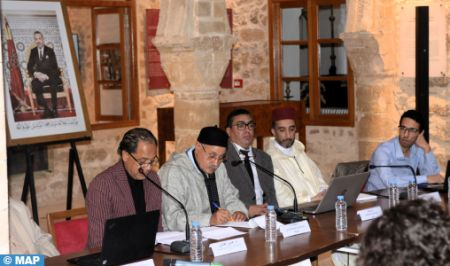
Issues of a national nature also found a place this year in this space of debate, notably the role of women in the political reform process that Morocco is experiencing, through the fifth edition of the Women's Tribune, a platform for reflection on solutions to the difficulties that women may encounter in their quest for equal opportunities, which was held this year in Essaouira (May 2-3) under the theme "Regionalization in the feminine: promises, assets, and challenges".
During this gathering, political and economic personalities, as well as representatives of civil society, from Morocco and elsewhere, debated issues related to regionalization in the feminine and the decentralization of powers in the service of equality between women and men and ways to build gender equality at the local level, with the aim of ensuring better governance. Thus, Essaouira, this quiet little Atlantic port embedded in an inhospitable land -at least in appearance-, has managed to build, against all odds, an important intangible capital that drives, in large part, a tourist activity that stands up to major national poles of attraction, better endowed with material means and infrastructure.
Culture 25 Dec 2014 5 min read
Essaouira gives substance to intangible wealth