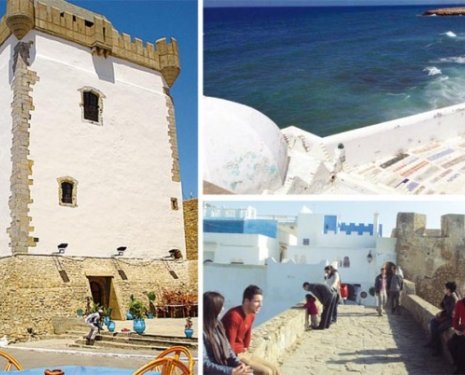
Endless walks, often in entire groups, long hours spent lounging around the beach and on the terraces of the multitude of cafés lined up next to each other, such is the daily life of the Azellachis and the many visitors to this small town where life is good despite the few distractions and cultural venues.
A way of life where simplicity, good nature, and above all an indefinable sympathy can be read on faces. Even more surprising is the fact that this lack of animation and this poverty in terms of leisure and cultural venues (only one cinema that exclusively shows Indian films, a youth centre, no theatre) do not seem to affect people's morale. As if boredom had no hold on them.
Visibly, the people here have known over time how to adapt to this local specificity which, under other skies, is unbearable.
Just as astonishing is the fact that this ease of living, this cheerfulness, is shared by everyone, young and old, because if the elderly have by force of circumstances the habit, the capacity to manage time that flows cheerfully without being prey to boredom, the young also seem well armed against idleness. They show no sign of despair, let alone weariness.
On the contrary, they seem to accommodate themselves to this situation. Their favourite pastime is swimming, walks, as well as impressive gatherings in the gardens and public squares that strike by their cleanliness and the beauty of their greenery and architecture. Very beautiful gardens that bear the names of illustrious poets, writers, and thinkers like Mahmoud Darwish, Tayeb Salih, Abdessalam Bekkali, or even Mohamed Abed Jabiri.
Another striking fact is the near absence of begging. Indeed, few poor people beg here and, better still, they are not like elsewhere in big cities, too insistent and aggressive in asking for charity, contenting themselves with a hand raised to the sky with almost no supplication or excessive display of their misery.
In Asilah, one walks a lot, non-stop walks late into the night, all along the cornice and on the main artery of the city, Boulevard Hassan II. As a result, the need to call a taxi remains exceptional. You have to wait a long time to see one, as they are so few, no more than 21 small taxis serving this city of 30,000 souls, not counting the thousands of summer visitors. On the other hand, people here prize a rather unusual means of transport, namely the horse-drawn cart.
All summer visitors as well as festival-goers invited to its cultural Moussem will tell you: Asilah is a city that seduces immediately by this sweetness palpable everywhere. Everyone is surprised by the kindness and great modesty of its inhabitants who reserve for the visitor a spontaneous benevolence. It is almost impossible to encounter a hostile look in this seaside resort which counts among the safest cities in the Kingdom.
News 12 Jul 2012 3 min read
Asilah, cheerfulness despite everything