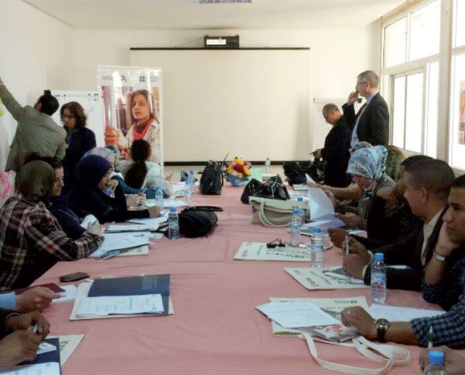
The Association of the Summer University of Agadir organised on 13, 14, and 15 July 2012 in Agadir, during its tenth edition, an international symposium under the theme: "The implementation of the constitutionalisation of Amazigh: challenges and perspectives."
Attending the symposium were association activists, intellectuals, and researchers from the four corners of Morocco and abroad, notably from Algeria, France, and Belgium.
The debates lasted three days and focused on current issues in relation to the situation of Amazighity, its stakes, its challenges, and the various projects opened in the aftermath of the constitutionalisation of Amazigh. At the end of this meeting, the participants drafted the Agadir appeal, approved during the closing session, the content of which is as follows:
"In the movement of the current situation; in the continuity of the various stages crossed by Amazigh militant action; in respect of the communiqués, platforms, and other bulletins produced by the Amazigh Movement, all sensitivities combined, the participants in this meeting, after having analysed the situation of Amazigh from linguistic, cultural, and identity points of view, both in Morocco and in the whole of Tamazgha and in the diaspora, address this appeal to national, Maghreb, and international public opinion:
1. Responsible mobilisation for the implementation of the officialisation of Amazigh:
-* a. Promulgation, as a matter of urgency, of the specific organic law for the operationalisation of Amazigh by imperatively involving Amazigh actors in the development of the draft of this law, in accordance with the government's declarations through its commitment to put Amazighity among its priorities; this, within the framework of preserving the achievements and choices concerning the institutionalisation of Amazigh through standardisation, obligation, generalisation, and the adoption of the Tifinagh character.
-* b. Adoption in the various public and private sectors, of prior and achievable provisions and measures in the short term (such as signage, the integration of Amazigh in the passport, the national identity card, the driving licence, and on the frontages of the various institutions); the mobilisation of material and human resources for translation from and into Amazigh in Parliament and in other public sectors; the use of Amazigh in stations, in airports, in services inside planes, trains, boats, and on all letterheads of administrative documents, ...)
-* c. Invitation of political parties and parliamentary commissions to open a deep and responsible debate on the organic law.
-* d. Exhortation of instances and other civil society organisations (cultural, human rights, women's, youth...) to multiply dialogue and debate meetings around the organic law with a view to crystallising the visions and proposals likely to formulate the draft of an organic law in phase with the aspirations and expectations of Moroccans in terms of the effective and practical officialisation of Amazigh.
-* a. Integration of Amazigh culture and language in establishments, institutes, and training centres covering the various fields of the Civil Service.
-* b. Generalisation of the teaching of the Amazigh language and culture in all school cycles and creation of Amazigh study streams and research centres in all universities and higher institutes by integrating Amazigh modules as a subject in the rest of the streams.
-* c. Creation of budgetary posts intended for Amazigh in regional centres for education and teaching professions and in universities.
-* d. Define Amazigh as a selection criterion for access to these centres and for the granting of exit diplomas.
-* a. Integration of Amazigh in training centres for mass media and communication with encouragement and support for creation in the various Amazigh artistic fields according to an innovative approach.
-* b. Increase in the quota allocated to Amazigh in the specifications of channels and other mass media by committing to diversify programmes and thematic missions in and about Amazigh.
-* c. Development and strengthening of means and techniques with a view to covering the entire national territory aiming to thus guarantee the citizen's right to information in Amazigh.
-* a. Establish an autonomous and citizen judiciary.
-* b. Take into account Amazigh, language, culture, and customary law, in the development of the draft reform of the judicial system and call on all components of the high commission to define and present their vision of the project.
-* c. Train the various stakeholders in the judicial system to adopt and implement qualification sessions in Amazigh language, culture, and customs.
-* d. Adopt documents written in Amazigh in the fields of justice and administration.
-* a. Add the mention "or Amazigh" after the mention "Arabic" in all legal texts in force (law on nationality, pleadings before courts, as examples)
-* b. Do justice to people who have suffered the prejudice of administrative delimitation by virtue of the Dahir of 03 January 1916 (as amended and supplemented), ruling on the system of delimitation of public lands and forest domains.
-* c. Establish the right of populations to benefit from the natural wealth of the space where they live (Ex: mines, water, forests, etc.)
-* d. Do justice to populations by lifting the prejudice caused by wild boar or illegal grazing.
-* a. Promote modern Amazigh culture in such a way that it meets the current expectations of individuals and society.
-* b. Rehabilitate Amazigh names and toponyms and correct the various falsifications that have affected them.
-* c. Evaluate and valorise Amazigh heritage and proceed urgently to the restoration of its physical component according to an integrated development approach.
-* d. Ensure imperatively and equitably, the representativeness of institutions, socio-economic operators, creators, and other Amazigh actors in all institutions, commissions, cultural and artistic events organised by ministerial departments in Morocco and abroad.
-* a. Revise the advanced regionalisation project by going beyond the narrow security and administrative approach and highlight, at the heart of regional policies, the Amazigh cultural dimension and factor.
-* b. Democratise regional and local service and involve the population in the management of local and regional affairs.
-* c. Develop marginalised regions and zones and guarantee the rights of populations to benefit from the wealth and taxes and other income of their respective regions.
-* a. The immediate cessation of all exactions infringing on the Amazigh language, culture, and identity in all fields, notably:
-* i. The prohibition of the registration of Amazigh first names in the civil registry.
-* ii. The prohibition of the use of the Amazigh language during debates in public places.
-* iii. The coercive attitude against the use of the Tifinagh character on banners, posters, leaflets, and printed matter.
-* iv. The disengagement regarding the teaching of Amazigh in several academies and delegations thus generating the demotivation of active teachers.
Thanks to its noble human values, Amazighity has contributed through its language, culture, and identity, to the liberation of the peoples of the Maghreb and North Africa as well as to the affirmation of the revolutionary spirit in favour of change and the accomplishment of dignity, justice, and equality for all citizens of these countries. This commits the Amazigh Maghreb and North African Movement to play today a leading role in coordinating its efforts as an avant-garde and reformist movement and to better define its global project with a view to succeeding in the democratic transition for all these countries. And this will only be possible by breaking the taboos linked to intellectual, political, and social underdevelopment and by rehabilitating the values of citizenship in favour of the peoples of the zone with all their components.
From this postulate, the participants call for:
-* a. The officialisation of Amazigh in the rest of the countries of Tamazgha following the example of the Moroccan initiative with a view to expressing the linguistic and cultural diversity that actually characterises these countries and protects them from the hazards of alienation and the misdeeds of globalisation.
-* b. Cooperation for the implementation of projects for the integration of Amazigh in education and mass media of all Tamazgha countries.
-* c. Exchange of visits with the aim of strengthening the bonds of fraternity and cooperation; exchange of experiences and expertise and development of agendas for consultation meetings with a view to deepening participatory work through international Amazigh organisations, particularly those of youth.
-* d. Scientific cooperation in the various fields of knowledge in relation to Amazigh, notably what relates to language in order to collect, record, and unify the language throughout the territory of Tamazgha.
-* a. Consultation with association actors of the diaspora.
-* b. Revision of the State's policy regarding its relations with Moroccans residing abroad, especially to guarantee them the right to political participation; revision of bilateral protocols between Morocco and foreign countries by guaranteeing the teaching of the Amazigh language and culture to residents abroad in accordance with universal values and global human rights treaties.
-* c. Revision of the agreement signed between the State and foreign institutes and schools established in Morocco with a view to guaranteeing the teaching of Amazigh in the same way as Arabic.
Given that the Amazigh Movement is a democratic, liberation movement and inscribed in the process of defending the rights of individuals and communities, by virtue of global human rights agreements and treaties, including what relates to the right to freedom, equality, and social justice..., the participants announce their solidarity with:
-* a. Prisoners for the Amazigh cause, calling for their immediate release,
-* b. All prisoners for just causes,
-* c. Movements claiming their cultural, social, and economic rights in the different regions of Morocco,
-* d. The Amazigh of Azawad in their legitimate struggle for a democratic and modern State.
-* Done in Agadir on Sunday 15 July 2012