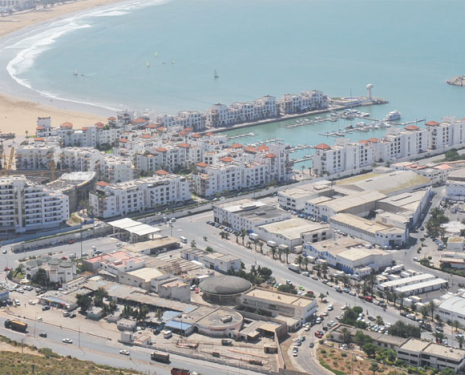
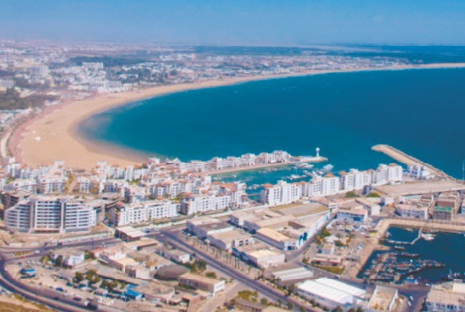
During this meeting, Abderrahim Oummani, president of the Regional Tourism Council of Agadir-Souss-Massa-Drâa, gave a presentation on the current situation of tourism in the city and the region, which has a total capacity of 16,999 rooms distributed as follows: Agadir 11,883 (69.90%), Ouarzazate 3,165 (18.62%), Zagora 800 (4.71%), Taroudant 406 (2.39%), Tiznit 382 (2.25%), Inezgane-Aït Melloul 282 (1.66%), Chtouka Aït Baha 81 (0.48%).
Tourism in Agadir represents a hotel capacity of approximately 27,000 beds, 780,000 clients, 4,300,000 overnight stays, 80,000 jobs, and 6 billion dirhams in revenue.
The number of arrivals in 2011 reached 1,082,121 (71.99% in Agadir), and 4,564,784 overnight stays (89.26% in Agadir).
During the year 2011, there were two periods: 1 January to 30 April and 1 May to 31 December. During the first period, arrivals increased by 19.87%, i.e., 255,349 tourists compared to the year 2010, when 213,016 tourists were recorded. Overnight stays also saw an increase of 18.17%, i.e., 1,386,490 compared to 1,173,274 overnight stays in 2010.
The occupancy rate went from 45% during the first four months of 2010 to 54% in 2011 for the same period, an increase of 20.14%. As an indication, the Polish market saw an increase of 141% for arrivals and 140% for overnight stays, the Scandinavian market 115% and 86% respectively, the national market 62% and 82%, and the Saudi market 49% and 47%. On the other hand, a decline of 29% for arrivals and 20% for overnight stays was recorded in the Russian market.
But after this improvement, tourism activity was rather gloomy during the second period from 1 May to 31 December 2011. Indeed, external demand experienced a decline for the following reasons: predominance of competing resorts, aggressive promotion by certain resorts in source markets, wait-and-see attitude and scepticism in source countries, lack of communication over a long period to reassure markets, risk-taking policy in terms of air travel by the resort's direct competitors, negative effects of the Arab Spring, impact of the Marrakech terrorist attack, effect of the economic and financial crisis affecting the world and in particular European neighbours, and the cancellation of several point-to-point air routes, thus widening the deficit in arrivals and favouring the isolation of the resort.
The year 2011 therefore ended with a decline in arrivals of around 0.93% in classified establishments, going from 786,307 in 2010 to 779,004 twelve months later.
Overnight stays also recorded a decline of around 6.95%, going from 4,378,655 in 2010 to 4,074,361 in 2011.
During the year 2011, the average occupancy rate of classified hotels in the city of Agadir recorded a decline of 6.89%, i.e., 50.73% compared to 54.48% in 2010.
A significant decline in certain traditional markets was noted: Russian (arrivals -52%; overnight stays -55%), Italian (arrivals -22%; overnight stays -27%), English (arrivals -14%; overnight stays -14%), Dutch (arrivals -14%; overnight stays -2%), French (arrivals -13%; overnight stays -14%).
And yet, the Agadir destination has several assets to showcase: climate (eternal spring), proximity to the main airports of source countries, beaches, golf, well-being, rich culture, fabulous hinterland…
Furthermore, the urban product has seen great evolution over the last five years: improvement of road and urban traffic infrastructure, commissioning of the Marina, development of the city's graphic charter and creation of urban furniture specific to the city, terrestrial opening with the opening of the Marrakech-Agadir motorway, opening of new modern establishments meeting the requirements of source markets, total or partial renovation of certain hotels, development of the seafront, upgrading of the road network, opening and electrification of the dual carriageway serving the airport, and development of roundabouts for better traffic flow in the city.
Despite all its assets, the destination still has certain weaknesses: lack of point-to-point flights to Agadir, insufficient promotion, lack of entertainment and places of attraction (play parks, water parks…), obsolescence of part of the hotel capacity, and hotel capacity still insufficient.
But the decrease in clientele from certain source countries is due to air transport problems. Indeed, during the year 2011, Agadir lost 15 regular or charter flights connecting it to European cities without stopovers.
The revival of this destination therefore imperatively requires the mobilisation of everyone: Ministry of Tourism, ONMT, elected officials, local authorities, professionals grouped within the CRT, and all tourism stakeholders, not forgetting the local population. Moreover, all the representatives of the different corporations who spoke during this meeting committed to making the necessary efforts to overcome the difficulties facing the sector in the city.
For his part, the minister, for whom this first visit is only a beginning, expressed his firm desire to work in perfect synergy with professionals, elected officials, and local authorities to resolve the problems raised, which those concerned did not fail to raise frankly, including those concerning the Taghazout, Founty, and Aghroud resorts.
At the end of the meeting, the minister declared to us: "During this meeting, we examined all the problems concerning the sector in Agadir. We also raised questions concerning investment and the Taghazout resort, which will constitute a structural project for Agadir. I also told the professionals and elected officials what we are doing in Taghazout, where work has begun. The government and the ministry attach importance to the first hotel being opened in Taghazout in 2014 or 2015. So, the work has begun, and the problems raised have been overcome. It is a structural project that will be beneficial for the populations of Agadir and Taghazout."
Questioned on this subject, the president of the CRT told us: "In 2011, we finished with a decrease of 01% in arrivals and 6% in overnight stays. Furthermore, we can say that there were two periods in 2011: a first period from 1 January to the end of April where we recorded more than 20% and a second which extends from 1 May to the end of December where we recorded a decline of 16%. This decline is essentially due to the economic, financial, and social crisis prevailing in source countries, the Arab Spring, and the Argana attack in Marrakech, which unfortunately had a very negative impact. That is why we have recommended an action plan in two parts: promotion, communication, and air transport for a budget of 689 million dirhams spread over three years, which can generate additional revenue of 4.2 billion dirhams. If we do nothing, in this difficult year where we could see -1%, we will surely have a decrease in revenue of around 1.2 billion dirhams with an impact on employment."
Tourism 28 Feb 2012 6 min read
Tourism in Agadir: After the improvement, the gloom
The Minister of Tourism, Lahcen Haddad, held a meeting last Monday at the headquarters of the Souss-Massa-Drâa region wilaya dedicated to tourism in Agadir. He is the second minister of the Benkirane government, after the Minister Delegate to the Minister of the Interior, Charki Draïss, to have travelled to the capital of Souss-Massa-Drâa. It should be noted that representatives of all concerned parties were invited to this meeting: CRT, RDTR, CPT, hoteliers, travel agents, restaurateurs, tourist guides and escorts, young promoters, service providers, elected officials, etc.