Here, just 68 kilometers from Marrakech, the change of scenery is total. Time seems to have stopped to block out the tumult of the city. And the small winding paths invite you to venture further into the valley where everything is authentic.
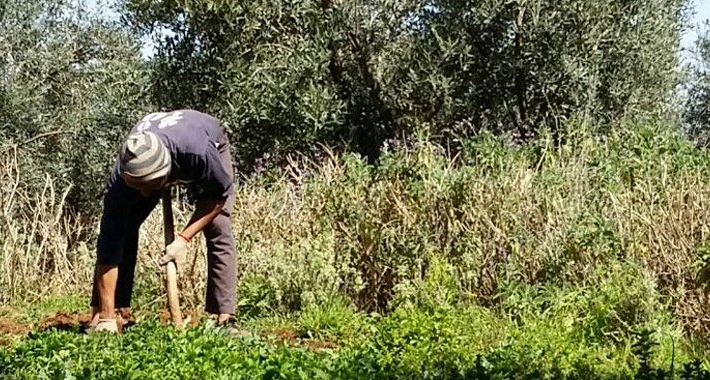
A world, cut off from the world...Walking through the alleys, it is the mountain that stands in the background. The landscape is breathtaking. And very quickly, the village buildings give way to olive trees. The trees seem to dance with the wind. And it is there, in the middle of these mint shoots, that we meet Mouhmad Oubihi.
The old man welcomes us with a curious smile. And very quickly, barely after the first pleasantries are exchanged, he invites us to share his tea flavored with freshly picked mint.
And as the discussion progresses, Ahmed introduces us to his world. A world of agriculture frozen in time which, from one generation to the next, has remained sterile to any form of modernity or evolution. "Here we do not cultivate the land to become rich, the land is for us the only way to feed ourselves, so we only sow what we eat," explains Mouhmad. And he continues, "Our ancestors lived on these lands and bequeathed us a treasure that we must respect. That is why we do not use any form of pesticide or fertilizer that is not natural."

Cultivating the land with respect for the land....
It is incredible and unthinkable at our scale! How, in our Morocco of 2016, can one still imagine that there are still people who sow and harvest only to eat! "Our cycle is simple, according to the periods, we sow the fruits and vegetables adapted and we therefore only eat seasonal products. In return, we always keep seeds from the previous season to start a new cycle," explains Mouhmad. And he continues: "Very often we are approached by government agents who offer us aid or subsidized seeds of better quality than what we have, but our land only takes its own fruit.
That's how it is and it won't change!". Here, habits are sacred. All systems, human relationships, hierarchies, were decided by the ancestors. Everything, down to the water management system.

Water for me and water for all....
The model of water resource management is quite particular in Tizguine. Water is a heritage passed down from father to son.
Thus, the whole village collects rainwater and water flowing from springs coming from the mountains in a kind of open-air basin. Then, a fairly complex system of aqueducts allows the "amazzal" (the one who makes the water run) to distribute, according to an ancestral calculation, the irrigation hours allocated to each plot.
"Amazzal knows everyone and manages to manage the irrigation hours according to everyone's shares. My brothers and I are entitled, for example, to half a day of water every two days and it is he who assigns them to us by blocking or opening the canals that lead to our lands," explains Mouhmad Oubihi. In this way, the small farmers of the village manage to cope with drought seasons and ensure their continuous supply of irrigation water.
Chicken farming, a matter for "breeders"...
In Tizguine, livestock farming is not the strong suit of the locals. The livestock is limited to a few rare heads of sheep, two or three cows, and a few chickens per household.
However, a very particular fact should be noted. Chickens are the business of women! It is frowned upon in Tizguine to see a man earning his living by doing poultry farming.
"Here, women never work in the fields.
They do not go to the market and enjoy a special rank in the household. Also, to allow them a certain financial autonomy from their husband, it is they who take care of the henhouse and thus earn their living.
It is therefore not uncommon to see a woman entrust chickens or eggs to her son or husband so that he can go and sell them at the market and give her the full amount earned," tells us Mouhmad Oubihi.
In short, our one-day trip to Tizguine was rich in discoveries. A return to the origins that deserved to be told. This article is therefore an opportunity to lift the veil on a piece of our Morocco that has chosen to remain authentic, virgin of any form of modernity, luxury, or superfluity. Yet in the village, children go to school, men speak Arabic in cafes, and young people connect to the Internet in the small cyber cafe around the corner. The paradox is great but does not bother. Doing organic farming, shunning mass production, and opting for organized watering remain the choices of the people of Tizguine who have found their balance in the love of their lands. Who knows? Perhaps tomorrow, these same young people who today connect to the Internet in the village will no longer want to cultivate the lands of their ancestors. Perhaps after Mouhmad Oubihi, the agriculture of the fertile and water-logged lands of Tizguine will take a turn towards mass production. In the meantime, Tizguine is what it is: A small, very welcoming village that makes you want to drop everything to grow food...