Ovationed in Kénitra as part of the women's festival and in Rabat at the Mohamed V National Theatre, "Larmes de Khôl" will be performed a third time on 18 April 2013 in Kénitra, the hometown of its director Asmae Houri.
The play, the third creation of the Anfass troupe, is the result of the collaboration of several talents: scenography and lighting by Abdelmajid El Haouasse, assistant scenographer Salaheddine Benabdeslam, musical composition by Rachid Bromi, music played by Rachid Bromi, Yassir Torjomani and Marouan Idrissi, singing by Khadija El Amoudi, costumes by Badria El Hassani and photos by Alice Feronce-Dufour.
The stage fright of the actors, the director... is known to everyone, because we talk about it often. But we never mention the anxiety of the spectator. Of this spectator called upon to participate in the reconstruction of the work. You see, you hear, you immerse yourself in a show that is offered to you, even though you have chosen to be there without placing yourself, a priori, for or against, and you are fascinated, dazzled, barely satisfied or enraged against yourself for having accepted to suffer two long hours of clichés and inanities, for having poorly used even a few minutes of the little time you have left to live by chewing over what your mind had vomited since time immemorial.
And you react. Immediately. Often viscerally. And no one can claim that you are not sincere. Even if the ipso facto reaction serves neither the show that is its object and catalyst, nor yourself. Even if you feel inspired, know that spontaneous verve is always touching but rarely sublime and rhetorical.
Black tears, transparent hearts
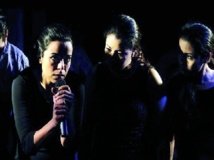
For me, it is a show that defines itself as unlimited, it is not classified but puts the spectator face to face with his own limits. While navigating it, I surprised myself wandering between all these symbolic constructions based on the number 4: four elements, four seasons, four men, four women; then I started to see something else: a man who is three times a man and once a woman and a woman who is three times a woman and once a man (scene of Ahmed who cross-dresses). I then thought I had grasped the meaning of the equation: there is in fact only one man and one woman. The woman dances, struggles, screams, howls, whispers and laughs frantically or bitterly or remains silent, playing her own role, while the man caresses the strings of his guitar, tickles those of his violin, drums on his cajon or hums a song with his female vocal cords. It is, so to speak, that it is the woman who sings in the man and it is the man in the woman who rides his rage and submits to the unspeakable and unbreathable laws of the sacrosanct family...
But in the end, I asked myself: do I not have a mind that is too geometric, excessively square to grasp the fluidity of the imagery of numbers in the recalcitrant universe of women who refuse that 1+1 is greater than 2, those to whom we deny the right to procreation and motherhood without the blessing of men?
Three women and one man dance and scream the pain of being in the man/woman, woman/man relationship in a phallic and theocratic society. Three men and one woman accompany them in music and song. When the former claim loudly, prosaically: "an emergency exit", the others reply, in cadence, lyrically: "no exit". And when the former dilute themselves in the choreography of the square that is made and unmade before turning into a straight line, sitting on the ground, at the foot of the wall; the latter dress their gestures and words with notes that rise crescendo, transporting them to the end of themselves, in a sort of therapeutic exorcism; then diminish, in decrescendo, in order to carry them to hear their inner voices.
The title of the play, which suggests an insert on a big screen, seems at first glance extra-theatrical, but when you find yourself under the ramp, almost feeling the actors' sweat, made unrecognisable by an ingenious staging. When you see these bodies that burst, break and shrivel, splay, tear and ball up, twist, curl up and wither to finally free themselves from a long-repressed anger, from the crazy desire to love, to be loved or simply to be ignored in a society devoured by indiscreet, inquisitorial and malicious curiosity: disrespectful of the inalienable, unsellable intimacy. This is what weakens the woman as well as the man, the man and the woman, that is to say the couple. The couple is fragile. The couple is in distress (SOS), that was one of the leitmotifs on which the scenography rested. Another refrain that repeats itself stubbornly on the backdrop is: dry; bear, dungeon, prison where one suffers dry, devoid of human warmth. Our homeland is in a way a dry country.
No accessory is chosen by chance: the necklace, for example, goes beyond its function as a dramatic stake: a pledge of love that transforms into a halter around the neck, to acquire a semantic charge, of an allegorical nature: its strange resemblance to the rosary tells us enough, and in a very subtle way, about the weight of religion in the life of a couple... The apple too, a consecrated symbol of original sin, fruit of the tree of the knowledge of good and evil, an allegorical figure of everything that is sinful and reprehensible, because forbidden or defended, takes on its full magnitude here as a substitute for a repressed and "de-naturalised" lubricity as if it were not part of the chemistry of our bodies... These apples voraciously devoured by women as well as by the man are only simulacra of denied, flouted and boxed-in desires...
Contrary to received ideas, it is the male character (Ahmed) who "suffers from this symboligenic castration, passing from the unconscious image of the body to the subjection of the latter to the image reflected (in the mirror)", the interpretation of Dolto's mirror stage prevails in the play over that of Lacan...
Finally, it is hope that triumphs, but this only permitted hope reeks of the compromise of silence: the only exit is inside oneself never outdoor or out of country. To exit also means to leave the stage. One cannot leave the stage. A month later, this scene still haunts me... I don't know about the others, but I won't soon forget this graceful upheaval of the senses.
News 15 Apr 2013 6 min read
"Larmes de khôl", a graceful upheaval of the senses