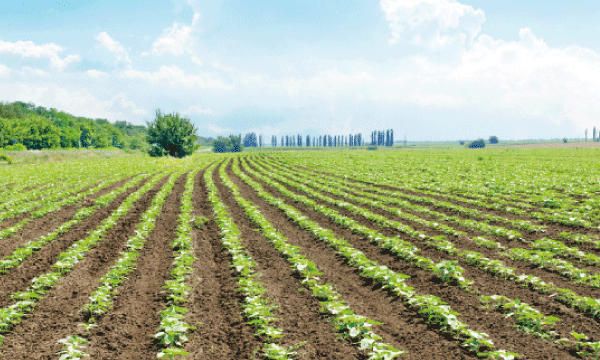
The development project launched recently concerns the collective lands known as “Guertilla” and “Telte”, with a total area of 5,000 ha, located within the territory of the Rural Commune of El Hammam (Khénifra Province), for a budget of around 10 MDH, at a rate of 2,000 DH/ha and with a pace of 1,000 ha/year.
The project is part of a partnership agreement concluded between the Naïbs of collective lands, legal representatives, on the one hand, and the High Commission for Water and Forests and the Fight against Desertification and the Ministry of the Interior, holding the guardianship of collective lands, on the other hand.
This agreement stipulates, in its broad outlines, the planting of forage species, peri-forest development, the implementation of the participatory approach, the improvement of plant cover, the reconstitution of forest ecosystems, the fight against desertification, and the encouragement of civil society and associations of collective land rights holders to take part in the development of the various stages of environmental protection.
This important project will allow for job creation, at a rate of one hundred days of work per hectare per year. The work, which began in good conditions during the year 2009, will be completed according to a physical schedule drawn up by the Water and Forests services.
This work will be spread over the completion of backfilling of protest elements on 300 ha, cover-cropping on 200 ha, the supply of 187,500 plants, 312,500 pads of spineless cactus, twenty tonnes of seeds, and weeding and hoeing of 500,000 protests. The financing that falls to the High Commission for Water and Forests and the Fight against Desertification for this work enters in its entirety into the “Boukhmis-Ain Abélioune” integrated development project for a budget of around 80,000,000 DH, which will be reserved, among other things, for forest development actions, securing the forest domain, reforestation, development of silviculture, electrification, development of fruit arboriculture, opening and rehabilitation of forest tracks, development of water points, and the allocation of micro-credit subsidies within the framework of support and accompaniment actions; in short, it is a profitable long-term project whose contribution is beneficial for a better future for the benefit of the populations.
Diagnosis of the situationThe guardianship department recently organised an important national debate on the stakeholders concerned, on the theme “Collective Lands: for sustainable human development.” This national debate aimed to develop, within a consensual and participatory framework, a diagnosis of the situation of collective lands, the examination of the main issues, and a prospective vision for the future of the management of this heritage that meets the aspirations of the various actors and partners. This vision will take into consideration the diversity and plurality of the different situations with the objective of better valuing this important heritage to make it a lever for economic and social development and a means to improve the living conditions of the rights holders and ensure their integration into the global development process.
According to a leaflet from the same department, the total area of collective lands across the entire national territory is estimated at 15 million hectares, distributed over 60 prefectures and provinces and encompassing 4,600 communities. 98% of these lands are directly exploited by ethnic communities, the remaining 2% are managed by the Guardianship through leasing, transfers, and partnership.