FrançaisEnglishالعربيةDeutschEspañolNederlandsItaliano中文

Your cart is empty

Adventure awaits!

About El Kbab

El Kbab is a Moroccan rural commune in the Khénifra province, in the Meknès-Tafilalet region.
It has a total population of...

News in El Kbab

Follow the latest news, projects, and official announcements from your commune.

News 21 Feb 2016 4 min read

Moha Oulhouceine Achibane, the illustrious Maestro who revolutionised Ahidous
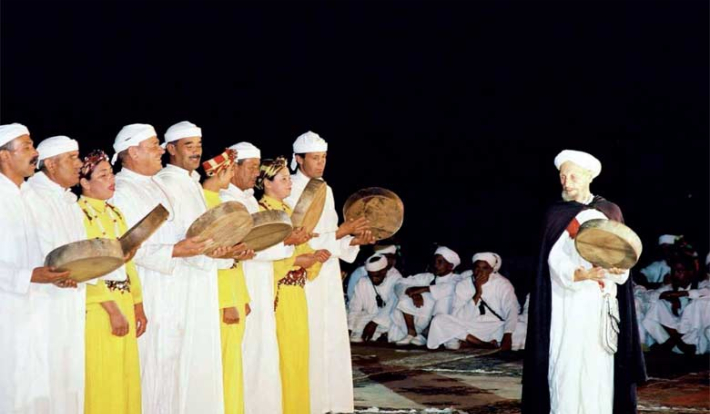
Moha Oulhouceine Achibane, the illustrious Maestro who revolutionised Ahidous

Since his birth in 1903, Moha Oulhouceine Achibane seemed destined for the career that made him famous. From a very young age, he loved singing and music while he was a shepherd and was leading a few heads of cattle to graze in the fields.

The maestro Moha Oulhouceine Achibane passed away at the age of 113, on Friday 19 February around 5:30 in the morning, at his home located in the Douar Azrou N’Ait Lahcen, circle of El Kebab (province of Khenifra) after a long illness.

Since his birth in 1903, Moha Oulhouceine Achibane seemed destined for the career that made him famous. From a very young age, he loved singing and music while he was a shepherd and was leading a few heads of cattle to graze in the fields.

At that time, he was also learning the Holy Quran in a "Msid" of the Douar. After the occupation of the region by the French coloniser, Moha Oulhouceine was forcibly enlisted with young men of his age into the French army. He thus fought, in the ranks of the colonial army, against the German offensive during the Second World War.

After the end of the war, Moha Oulhouceine returned to Morocco where he was assigned to the 23rd Moroccan Goum. He was subsequently a Mokhazni chief in Settat, then a horseman with the military command in Imilchil and Boudnib.

One of the highlights of his military career was his dismissal from the French army, after having refused to open fire on Moroccans in a mosque in Casablanca. He subsequently returned to his Douar where he joined the ranks of the Moroccan Resistance fighting for the independence of Morocco, given his great experience in handling weapons.

His artistic career only began around 1950 at the centre of Tighassaline (province of Khenifra), where he formed a troupe composed of sixteen men only. After his first successes, Moha Oulhouceine introduced women with the aim of orchestrating Amazigh singing with harmony within the artistic framework of Ahidous, a dance specific to the "Ichakiren" tribe.

It is public knowledge that the women who joined his troupe were none other than the wives of the men who were already in it. Thus, the troupe was continually composed of couples who shared the passion for Ahidous.

Thanks to his flourishing artistic career, Moha Oulhouceine, at the head of his troupe, distinguished himself during the organisation of the various editions of the Marrakech Popular Arts Festival and at the Fez Festival of World Sacred Music, where he was able to orchestrate the art of Ahidous with mastery.

He also performed abroad, notably in the United States where he was nicknamed "Maestro" by Ronald Reagan, president at the time. Still at the head of his troupe, Moha Oulhouceine subsequently performed in France, Germany, Italy, Spain, the Netherlands, Algeria, and Ivory Coast.

Moha Oulhouceine married three times. After the death of his first wife, Rkia, he remarried a woman who bore the name Rabha. The latter accompanied, supported, and encouraged him during his artistic career.

As for his third wife, her name is Mamma. Among his six children, it is Lhousseine who took over, after his father decided to voluntarily withdraw from the artistic scene.

This great artist holds several honorary titles. He was decorated by H.M. King Mohammed VI in Tangier in 2002, on the occasion of the festivities commemorating the Feast of the Throne, with the Wissam Al Moukafaa Al Watania, in tribute to the loyal artistic services he rendered to his country, both nationally and internationally.

He passed away on Friday 19 February and was buried after the Al-Asr prayer, at the cemetery of the Douar Azrou N’Ait Lahcen, in the presence of personalities who came from several cities of the Kingdom.

Let us express the wish that research be initiated, either by the Royal Institute of Amazigh Culture in Morocco or by Moroccan NGOs, in order to highlight the lyrics, gestures, and symbols that the late Moha Oulhouceine Achibane used, during his lifetime, at the head of his legendary troupe.

Listen
Size: