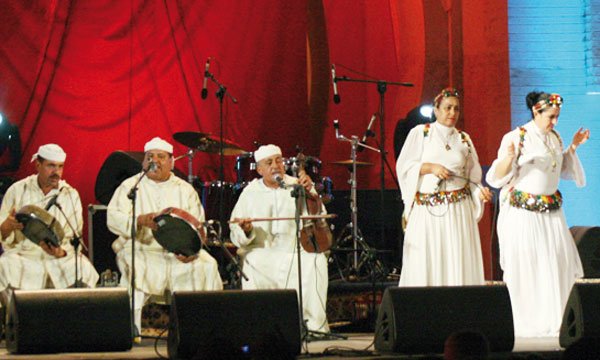
After the success achieved by the fifth edition of the "Taïmat" Festival for Amazigh culture, the sixth edition of this important socio-cultural event was held from 6 to 9 August in the centre of the locality of Aït Ishaq (Khénifra province), around the theme: "Valuing the diversity of identity is the essential access for the realisation of sustainable development". The festival is initiated by the Aït Ishaq communal council, in collaboration with civil society associations, local actors, and Moroccans residing abroad who originate from the rural commune of Aït Ishaq.
A rich and varied programme was developed by the organisers, which includes, first and foremost, the promotion of Amazigh culture and the typical traditions of the Aït Ishaq tribes, an ancestral natural heritage and cultural treasures to be protected, such as "Ahidouss" with its poetic songs, a strong link of an entire region that has preserved all its authenticity and its millennial oral heritage. Amazigh culture is thus represented in its diversity through collective rites of songs and dances, with oral finesse and remarkable order, through a rhythmic movement, mixed with poems in a cadenced pace that reflect daily life, nature, and the customs and traditions of the tribes, sometimes with a philosophical sense.
It is in this way that a panoply of the best Amazigh poet groups, "Inachadane", from the entire region: Tighassaline, Ouaoumana, El Kebab, Aït Ishaq, Sidi Yahia ou Saad, Aghbalou, Zaouiate Cheikh, El Ksiba, and Khénifra, came to take part in this unique gathering of its kind. In short, the folklore of the Middle Atlas is far from being a circumstantial manifestation; it is rather the culture of a people with ancestral traditions, rich in memorable events, legends, and customs.
Indeed, the Tamazight language, a millennial linguistic corpus, is an integral part of the cultural heritage and reflects the mentality of a people, whose folklore generally expresses the needs of the men and women who are its reproducers, with the aim of communicating through music, ritual, and symbolic gestures that they perform together, often spontaneously. It is an active heritage that is transmitted orally between the "Inachadane", from generation to generation, while allowing each tribe to preserve its true identity.
The second component that characterised this festival and to which the organisers were keen to give pride of place is the fantasia (Tbourida), in order to contribute to promoting this traditional equestrian art. Indeed, this art has been anchored for centuries in the daily life of the various tribes of the Middle Atlas, who take great care in horse breeding. Taking care of the maintenance and training for a perfect balance of the horse-rider pair, a balance that must allow at any moment the execution of the best figures, according to the rider's orders. Owning a horse is an honour for every man of the tribe; it is part of Amazigh culture, in particular, and the history of Morocco, in general. To promote this heritage and equestrian traditions, about thirty "serba" groups from Aït Ishaq, Ouaoumana, Tighassaline, Sidi Yahia ou Saad, Zaouiate Cheikh, El Ksiba, Tadla, Aghbala, Aghbalou, and Khénifra were invited to take part in this important festival which reflects in its entirety the historical retrospective of the Middle Atlas tribes.