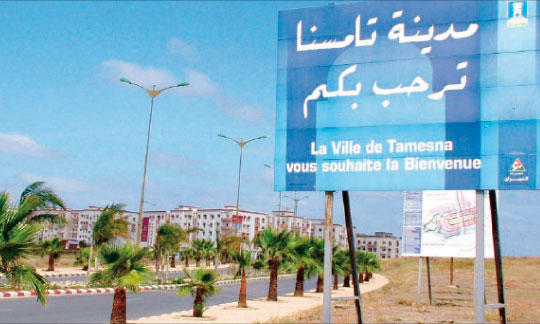
Several years after its launch, the Tamesna project still sparks debate. This time, the subject was brought back to the table by the Istiqlal group in the House of Councillors, last Tuesday during an oral question session. Not surprising, since the file never stops making people unhappy. In addition to the insufficiency of infrastructure and transport problems, the group pointed the finger at the delays in the delivery of apartments.
Several families still bear the costs of rent while waiting to be given the keys to the apartments they paid for in hard cash. In response to these grievances, Nabil Benabdellah, Minister of Housing, Urban Planning and Urban Policy, believes despite everything that the Tamesna experience is quite successful. He acknowledges that there are a "certain number of imbalances that must be remedied, without forgetting the progress recorded." Regarding the delay in deliveries, the minister specified that this problem in no way concerns national developers. According to him, it involved two foreign companies. And he added, "the ministry intervened to resolve these disputes so that the delivery of the apartments takes place as soon as possible." But for the moment, the inhabitants of Tamesna continue to live a real ordeal in the absence of infrastructure. Recently, they held a sit-in in front of Nabil Benabdellah's department to denounce the almost total absence of basic infrastructure, the insufficiency of collective equipment and connections to electricity, water, and sanitation networks, as well as urban mobility problems linked to the lack of public transport means connecting the satellite city to other parts of the Rabat agglomeration. Indeed, transport difficulties remain the major problem that weighs down this new city. An observation confirmed by one of the inhabitants: "We are living a real ordeal because of the absence of infrastructure. Notably, transport. This problem still arises despite the discussions engaged with the officials, but without any result until now. Today, the mobility problem is increasing more and more. And it is the pupils and students who suffer the most." Still on the subject of urban mobility, the inhabitants of Tamesna point the finger at the delay recorded in the implementation of the bypass connecting Rabat to Tamesna. A project that is recording a huge delay while it remains vital for the development of the city both for the mobility of people and for economic activities. Because the success of this type of city should be accompanied by an economic take-off. As for public facilities, they are also the weak link. The inhabitants of Tamesna complain about the lack of schools, health establishments, and a mosque. A resident emphasizes that "it is inconceivable that a city of such a size is not endowed with a mosque to perform prayer." The isolation of the inhabitants of Tamesna also brings back to the table the issue of security. "Families are worried about their children because of the multiplication of cases of aggression targeting girls in particular," explains one of the inhabitants, distressed.
Global approachIn any case, the supervisory ministry promises to overcome these shortcomings. It claims to have made the upgrading of new cities a priority. According to Amina Bouktab, Inspector General of the supervisory ministry, "currently, a special ministerial committee is working on an action program whose priority is given to new cities and we will find solutions to all its problems in the short term." This official also noted that the upgrading of Tamesna is not only the business of the Ministry of Housing, but of all ministerial departments. Because, according to her, "the problems that arise today relate to several sectors such as health, equipment, transport, and education." A global and multisectoral approach must be adopted. Without forgetting the importance of public-private partnerships to make satellite cities real levers of development.
Prerequisites to respect
Until today, the experience of the city of Tamesna, supposed to represent a model of success of the government's policy, has not been successful in all respects. The city is rather likened to a dormitory town than anything else.
For its upgrading, officials must think about the means likely to promote its attractiveness. And this can only be done through the establishment of a transport network both internal and external. It is an unavoidable prerequisite if one wants to contribute to social cohesion and promote an integrated living environment.
-* Sit-in by Tamesna residents to denounce the insufficiency of collective equipment
-* The House of Councillors questions the supervisory minister
-* The transport problem comes at the top of the grievances expressed
-* A ministerial committee is looking into the new cities file.