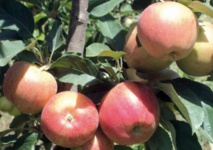
After having experienced, three years ago, the tragedy of fungal diseases, especially apple scab, a fungus that attacks the foliage of trees as well as the fruit where one observes the formation of corky scabs on the skin, the optimal temperature for proliferation as well as the dry climate of this season have intensified the reproduction of large masses of red spiders, parasites smaller than a millimetre, difficult to see with the naked eye, infesting the apple orchards in Imouzzer Kandar, and leaving behind enormous damage. This pest of the mite family hibernates in the form of eggs deposited on tree bark and at the base of buds; in August, they form red patches which, towards the month of April when the temperature really starts to climb, hatch to give future colonies of spiders, depending on weather conditions. At the adult stage, a single female can lay up to 100 eggs during her short life, hence a multiplication speed that can be very significant if the climate is both dry and hot. Such a climate alerts farmers to proceed with repeated treatment operations by spraying active substances fighting against mites. "Normally two or three foliar treatments per agricultural season are enough for us to reduce to a minimum the attacks of the cursed spider, but this year, it has shown great resistance, which has pushed us to multiply the treatment operations with different brands of acaricides available on the market, operations that have amounted for me to six, but still without the expected result," explains O. Ali, a farmer, who fears an increase in expenses without seeing his harvest improve. An increase due mainly to the additional purchase not only of phytosanitary substances having a direct action against spiders but also of foliar fertilisers to remedy the damage caused by the latter on the foliage of trees and apples. The climate prevailing from the second quarter of this year in the Séfrou region, a climate that is both dry and hot, favours the accelerated reproduction of colonies of tiny parasites which in turn develop a remarkable resistance to the cheap chemical substances available on the spot; the absence of awareness campaigns are all factors that make them, this year, a weapon of mass destruction for orchards and the harvest which is withering before our eyes. The attacked leaves turn yellow, brown, and take on a leaden grey appearance. Their photosynthetic activity is then reduced to its lowest expression. By its microscopic nibbling, the little monster manages to suck the sap from the leaves of fruit trees and mainly apple trees through its action on the chlorophyll activity of the leaves. If the attacks are numerous, it can also cause a depreciation of the quality of the fruit in terms of size and sugar content as well as the floral activity of the following year. How is it possible to turn one's back on a region known on a national scale especially for the quality of its noble fruit? It is ironic to see these farmers facing their destiny alone with increasingly resistant diseases, and this in a region near Meknès where the International Agricultural Exhibition takes place every year, of course on the lands of Green Morocco.
News 17 Jul 2014 3 min read
Imouzzer Kandar apple trees ravaged by red spiders