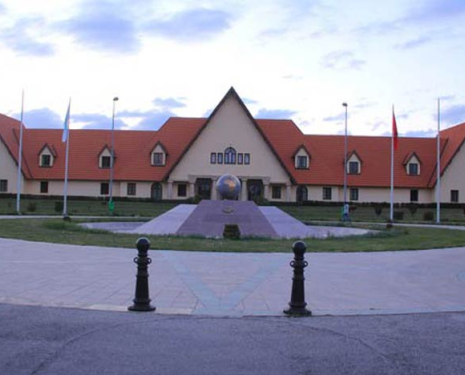
Today, and more than ever, human capital is placed at the heart of the company's strategy. Indeed, good human resources (HR) management allows companies to master their internal organisation and reduce social risks and inter-employee conflicts. In this context, Al-Akhawayn University in Ifrane hosted, on 16 March, an international symposium on the theme: "Good practices in human resources management, examples from Morocco and the United States". This symposium, which saw the participation of Moroccan and American academics, businessmen, and students, was an opportunity to identify the impact of human resources management on the performance achieved by companies in the 2 countries.
Thus, on this occasion, Maria Cseh and Shaista Khiliji, teachers at George Washington University in the United States, presented the basic principles of human resources organisation in their country. They thus made it known that the good practices on which human resources management in American companies is based concern in particular continuous training, coaching, the development of creativity and innovation among staff, the creation of a healthy workspace where a good atmosphere reigns, the development of the employee's social responsibility by involving them more in the company's strategy and by boosting their sense of belonging, as well as building trust among employees.
HR management practices in companies in Morocco were then scrutinised by several experts in the field. The experience of CDG Development in the field of human resources management was thus presented by Hamza El Hajoui, HR manager. "At CDG Development, our greatest challenge in terms of HR is the management of this diversity of trades that we have. Staff is above all human capital that must be retained and motivated. Our way of going about it consists of moving to a learning HR organisation, where the company strategy is proactive and where all staff are engaged and involved," he specified. And to add, "we also make sure to ensure our collaborators have the capacity to adapt to our strategy and the various changes that can occur there, and this, via continuous training. For this reason, we have set up the CDG Institute, whose mission consists of creating an internal dynamic and allowing our staff to be prepared for any eventual change."
For Khalid Lahbabi of CMCP Int. Paper, a multinational established on 4 continents, there are 3 main tools that are the keys to the success of an HR strategy. Namely leadership, responsibility, and results. "We attach great interest to these tools. As for leadership, we have a programme to develop it at all levels of the organisation. In this context, the CMCP Leadership Institute in Memphis in the United States welcomes those among our collaborators who distinguish themselves by their competence and commitment. Concerning responsibility, it is a matter of calling upon mechanisms that align the company's objectives with individual objectives. Finally, for the results component, we regularly hold to obtain permanent feedback from our staff by displaying the company's objectives and by identifying skills. In this context, we set up 4 evaluation sessions annually, where it is a question of having staff feedback on the business result as well as on personal development," he explained.
Furthermore, according to Walid Meski, HR manager at Toyota North Africa, the watchword of his company in HR is the involvement of staff in the development of its strategy. "At Toyota, we use the term associate and not employee to qualify our staff. Indeed, through brainstorming sessions in particular, we try to involve our collaborators in the implementation of our managerial strategy, this is what is called HR Business Partnership. To achieve our objectives, we attach great interest to continuous training, the development of career plans, as well as the working conditions of our associates. Our motto is, make the company a pleasant place to live for our associates," he indicated.
Another factor, which was furthermore pointed out by all the participants for its determining role in any HR strategy, is staff engagement. For them, engagement is very important in the sense that the development of engagement among employees gives rise to a sense of belonging among them, and incites them to automatically defend the company's values and try to disseminate them, which has a positive impact on the company's financial health.
Placing human resources at the heart of its development strategy, the La Mamounia hotel in Marrakech has established innovative projects in terms of HR. Thus, in addition to social surveys carried out regularly to measure the degree of staff satisfaction, the HR managers of La Mamounia had the idea of team-buildings in order to strengthen team spirit and communication between staff members. Investing in musical or audiovisual team-building projects, employees had to share moments of relaxation and entertainment far from the daily stress of work, which consequently developed in them the spirit of solidarity and complementarity. The "Live my life" project, which consists of putting oneself in the shoes of another employee for a day to discover their job and its constraints, was also set up by the HR management of La Mamounia. This experience succeeded in improving communication between staff members and creating cohesion within the group.