His Majesty King Mohammed VI, may God assist Him, proceeded, on Tuesday in the Gzenaya urban commune, to the inauguration of the Boukhalef wastewater treatment plant and the system for the reuse of purified water, a project strongly revealing of the particular attention that the Sovereign pays to the protection of the environment and sustainable development.
As an integral part of the "Tangier Metropole" programme, this project (250 million DH) is part of a large programme for the depollution of the coastline from Cap Malabata to Assilah (65 km) and aiming at the improvement of bathing water quality, the urban and tourist development of the city, the elimination of olfactory nuisances, the reduction of greenhouse gas emissions, and the preservation of water resources.
Intended in a first phase for the treatment of wastewater intercepted on the Atlantic coast between Cap Spartel and the Houara zone, as well as those of the Gzenaya commune, this project consisted of the commissioning of a complete treatment, the laying of collectors for the interception and transfer of wastewater to the treatment plant, the installation of pumping and lifting systems, the construction of a storage basin and a pumping station, and the laying of 8,553 linear metres of piping for the distribution and, thus, the reuse of treated water in the irrigation of green spaces in the southern zone of Tangier.
This achievement will allow, in a first phase, the treatment of a volume of 11,000 m3/day (140,000 population equivalent) of intercepted wastewater, with a tertiary treatment capacity of 5,000 m3/day, i.e., a watering and irrigation area of about 100 hectares/day.
Meeting international standards and using the latest technologies in wastewater treatment, the new station adopts a process called "activated sludge" with tertiary treatment, a formula that allows for the treatment of sludge and odours and the production of water compliant with Moroccan standards relating to the quality of water intended for irrigation.
In a second phase, planned for 2017, the extension of the depollution system will allow the collection and treatment of the rest of the Atlantic coast between Houara and Assilah for a total volume of 16,000 m3/day for (210,000 population equivalent), as well as the extension of the distribution network of purified water to reach a watering and irrigation area of about 200 hectares/day.
This project reinforces the various structural projects launched at the level of the capital of the Strait, notably those undertaken within the framework of the flagship "Tangier Metropole" programme which gives pride of place to environmental issues and questions related to connectivity and the movement of people.
This is the case for the project for the construction of underground car parks and the one relating to the development of a direct access from the Rabat-Tangier motorway to serve both the Beni Makada district and the future Ain Dalia industrial zone.
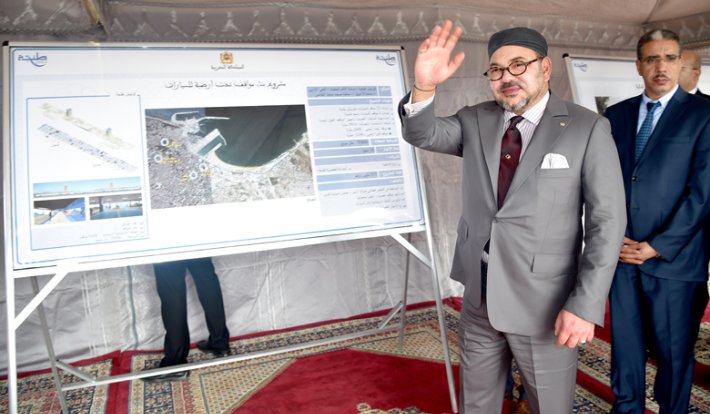
Realised within the framework of a Public-Private partnership, the project for the construction of underground car parks (2,680 spaces) requires a total budget of 553 million dirhams. It concerns the construction of 12 car parks (1,438 spaces) at the level of the Tangier Corniche and four others at the level of the Place des Nations Unies (410 spaces), the administrative district (130 spaces), Place 9 April (452 spaces), and the esplanade of the Mohammed V mosque (250 spaces), the objective being to ensure more fluid traffic as well as a more pleasant living environment for the inhabitants and visitors of the city.
This project also provides for the development of public squares and areas for the location of underground car parks, and open-air parking lots with an additional capacity of 3,244 spaces. Note that of the sixteen planned car parks, six are under construction.
The project for the development of a direct access from the Rabat-Tangier motorway to serve both the Beni Makada district and the Ain Dalia industrial zone (250 million DH), consists of the construction of an interchange at the level of the Rabat-Tangier Med motorway and a 6.2 km access road with two lanes, the development of green spaces and sidewalks, the installation of street furniture, and the extension of the public lighting network.
Realised within the framework of a partnership between the Ministry of Equipment, Transport and Logistics, the National Company of Motorways of Morocco, and the Tangier-Assilah prefecture, this project which records a progress rate estimated at 10% will allow for the easing of pressure on the various entrances to the city, the improvement of access to industrial and logistical zones, and the strengthening of road safety.