FrançaisEnglishالعربيةDeutschEspañolNederlandsItaliano中文

Your cart is empty

Adventure awaits!

About Fès-Medina

The city of Fès, known at the beginning as Fès al Bali, was founded by Idris I on the right bank of the Oued Fès. Alongside...

News in Fès-Medina

Follow the latest news, projects, and official announcements from your commune.

Festival 08 May 2016 5 min read

Asian songs resonate in the sky of Fes
Asian songs resonate in the sky of Fes

Between India, Iran, and Azerbaijan, festival-goers were spoilt for choice during the second day of the Festival of World Sacred Music.

The public who came to attend the striking concerts of the second day of the Fes Festival of World Sacred Music seemed spellbound. Indeed, a "mystical" atmosphere reigned at the Jnan Sbil Garden where two shows took place. First, the garden welcomed one of the stars of Persian classical music, the Iranian Sahar Mohammadi. With her noble and incisive voice, she transported the public under other skies where women interpreted the great repertoire of the Radif musical system. Encouraged by her vocation and rich in her heritage, Sahar favours authentic emotion. An emotion felt and shared by the public who came especially to hear her sing and marvel at her talent. Still at Jnan Sbil, a group of young women from Azerbaijan conquered the public with their playing of the Qanun instrument. Dressed in their traditional costumes, the Ingie excelled in collective playing, worthily representing the Azeri tradition of Baku and the richness of this heritage where Turkish, Persian, and Caucasian elements mingle.

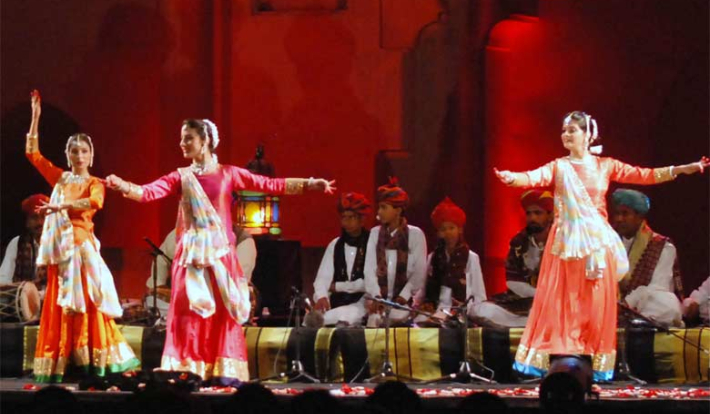
Another stage, "almost" similar atmosphere. While some fans of Indian popular music were more or less disappointed, lovers of "classical" music enjoyed themselves at Bab al Makina, by attending Durbar. It is a show created especially for the 22nd edition of the Fes Festival of World Sacred Music and which brought together fifteen Indian classical soloists and percussionists, singers from Rajasthan, and Kathak dancers. A mixture of sounds, voices, and choreographies that recalls the time when prestigious musicians and artisans exhibited their art, their gestures, their musical knowledge, and their mastery before the Mughal Nawabs. To better represent this ancestral art, the greatest singers and musicians of India challenged each other on stage in a captivating musical joust.

The magic well and truly operated during the opening show of this 22nd edition. Different artists followed one another on stage in parallel with the stories told by Scheherazade, interpreted by the Moroccan actress Nadia Kounda. A look back at this artistic event, with its director and artistic director of the festival, Alain Weber.

Le Matin: Tell us about the opening show "A sky full of stars"? Alain Weber: The idea was to create a dream. A sky full of stars refers to these women who marked history through poetry, music, the sacred, religion… it is a way to pay tribute to them. That is why we thought of creating a kind of children's tale where Scheherazade finds her little sister Dunyazad (played by the young Moroccan Dikra Al Kalaï). Because we often forget that in the tale of the Thousand and One Nights, Scheherazade first tells stories to her little sister. So the goal was to create a tale with lots of stories, but above all to highlight many female artists having very beautiful voices.

What are the difficulties you encountered while preparing the show? It is a show that we prepared for six months, or even a year. So the first difficulty was the work to be accomplished: finding the orchestra, creating the mapping, looking for the artists… bringing all these elements together requires a lot of time. But the real challenge we were faced with was the climate. The climatic upheavals of the last few weeks prevented us from following the rehearsal programme as it should be. Result, we rehearsed for five or six days, whereas normally for such productions, we rehearse for at least two weeks. Fortunately, thanks to the work of the artists and the "feminine wisdom", we were able to obtain a beautiful result.

Nadia Kounda had already played the role of Scheherazade on television. Did you select her for this reason or by chance? Already, I must point out that I made the selection of all the artists with the idea that the Orient, Morocco, but also the different religions, be represented in this show, that there be a real cultural diversity. Concerning the character of Scheherazade, I had seen Nadia in one of the first films in which she had played "L’amante du Rif", but I had not seen her in the soap opera where she had played Scheherazade, so it is a pure coincidence. I chose her because I was looking for a young actress, pretty of course and especially who has good articulation. Because the problem we encounter at Bab al Makina is often acoustic and so the public sometimes has difficulty understanding what the artist is saying. With Nadia, the words were very clear.

How did you manage such a multicultural team? The team harmonised all by itself (laughs). I must say that everything went very well. The wisdom and peace that reigned, despite the difficulties encountered during the rehearsals. I think this is due to the fact that despite cultural or religious differences, these women have many points in common, plus they are artists and therefore open to communication. And then, I must admit that I was lucky not to have been confronted with ego problems. Each of the female artists respected her timing.

Listen
Size: