Throughout these last few years, the city of Rabat has not stopped transforming itself. There are many projects that have changed the face of the agglomeration both economically and urbanistically (the new city of Tamesna, the development of the Bouregreg valley, and Technopolis). Rabat is experiencing a real urban revolution accompanied by considerable demographic expansion. However, this increased urbanisation remains out of step with the system ensuring the mobility of the population. The latter is moving today more and more (work, universities, schools, and leisure). A situation that exposes the failure of urban mobility in Rabat. A major challenge. Because it raises the question of the right to mobility, one of the basic rights of citizens. Indeed, Rabat suffers from a weak structuring of the urban transport network, thus hindering the mobility of people, particularly the massive movements of public transport users. While studies on origin-destination flows have shown that the majority of trips are made within each of the agglomerations, and that the main destination is the centre of Rabat. Thus in Témara, 58% of the population's trips are made within Témara and 30% are made essentially towards Agdal, Hay Ryad, and Hassan. Similarly in Salé, 60% of the population's trips are made within the city, 35% are made towards Agdal, Hay Ryad, and Hassan, and 74% of trips are home-to-work. Admittedly, Rabat has opted for a "tramway" solution to further fluidify traffic and meet the needs of the population. But this remains insufficient for many citizens for whom the tramway has not solved the mobility problem. Some areas are not served by the tram (social housing in the periphery of Rabat and new administrative and business districts).
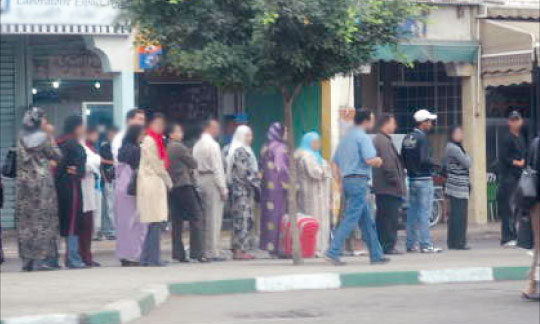
Technically, Rabat's current urban transport system includes two systems. The first is well-structured, that is the tramway. As for the second, it encompasses small and large taxis as well as buses. At the level of the latter, users of this mode of transport no longer know which way to turn. Morning and evening, they live the ordeal of bus delays. One has to wait for long hours for a bus to finally arrive, most of the time packed to the rafters. For others, those who get tired, they prefer to squeeze into pick-ups equipped with benches or into private cars. This scene is now part of the city's daily decor. Informal transport tends to be integrated into the formal, in full view of the authorities. Indeed, as soon as Veolia disengaged, the informal transport sector reached its peak. Bab Al Ahd Square, Ibn Toumert Avenue, and Ennakhil in Hay Riad remain the most well-known gathering points for clandestine transporters.
Moreover, the proliferation of "Khettafa" (clandestine transporters) was one of the causes of the departure of Veolia, which was in charge of managing the sector. And even with the resumption of the management of the sector by the Al Assima group, informal transport occupies a place of choice. It must also be said that it is increasingly requested by users because of its abundance and the insufficiency of the bus supply.
A finding that persists even after the takeover of the management of the sector by the Al Assima group. The expected objective was to put in place a modern and efficient urban transport system allowing for the overcoming of the dysfunctions plaguing the management of public transport. Thus, the mobilisation of funds for the strengthening of the bus fleet was the number 1 goal.
In this sense, Al Assima's great ambition was to reach a fleet of 500 buses by the end of this year, with a view to further strengthening the fleet to meet the needs estimated at 600 buses. Admittedly, the group proceeded nearly a year ago (November 2011) to the acquisition of 50 buses, but since then nothing has been done to achieve this objective. Until this objective is realised, the Rabat citizen will opt for a tramway, a trip on board a pick-up or a "khettaf", or will resign themselves to waiting for a bus packed to the rafters and rarely punctual!
Complementarity between Tram and bus is more necessary than ever
Despite the efforts made to upgrade the public transport network, much remains to be done. Admittedly, the tramway has demonstrated, after one year of its commissioning, its efficiency, by reaching 80,000 passengers, but the complementarity between these two systems proves to be more necessary than ever to serve and ensure the movement of the entire population. Because the development of public transport should not be limited to the diversification of modes, but must also ensure the coordination of their operation. Today, it is appropriate to make public transport the preferred means of travel for citizens, both for economic and ecological considerations.
-* The public transport network is out of step with the capital's dynamics.
-* The Rabat tramway saves the day.
-* Informal transport continues to grow.