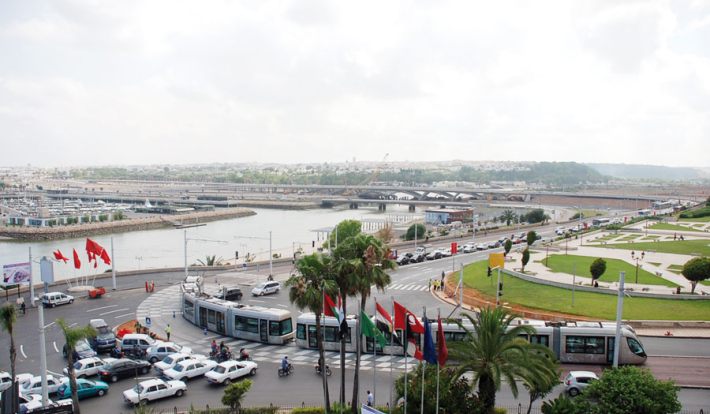
The Bouregreg Valley Development Agency (AAVB) had a meeting with the Rbatie and Slaouie civil society last Thursday in Salé. Objective: to open the debate on the Bouregreg projects, take stock of the progress of the achievements carried out within the framework of the valley's development, and present future projects. Unlike previous meetings, this one saw the participation of the "Ribat Al Fath" association.
Mekki Zwawi, president of the Bouregreg Association, considers that the agency should not limit itself to press conferences. Meeting and consulting with civil society are also important. "This meeting with the officials of the Bouregreg Agency and civil society is intended to be a mechanism for monitoring and dialogue to ensure the future of the two cities and allow citizens to become thoroughly acquainted with both the progress of these projects and the constraints related to them. The idea is to have clear visibility on these projects and to opt for consultation around these projects". In short, discussing the ins and outs of this pharaonic project and debating the foreseeable economic and social impacts are all goals set by the initiators of these meetings held annually since 2006. On the menu of this meeting, the thorny issue of mobility between Rabat and Salé, the depollution of the Bouregreg valley, and the real estate projects started in Salé, notably the major "Bab Al Bahr" and "Saha al Kabira" projects.
In his speech, Elmghari Essakel, DG of the AAVB, spoke at length about the creation of the agency, the importance of its projects, and the challenges to be met, given that several initiatives had been undertaken in this direction since 1954, all of which failed. After giving a historical overview of the agency, the DG of the AAVB had to explain to the participants that it had to face several institutional, legal, and technical problems, because these were very difficult projects for which priority was given to transport, the establishment of basic infrastructure for the benefit of the citizens of both banks, as well as the promotion of river navigation and the creation of jobs. During this debate, Elmghari Essakel was reassuring about the continuation of these projects despite the economic crisis, the repercussions of which are inevitable for the Kingdom.
"The agency has been able to meet the challenges, and the pace of work is on the right track. And this, contrary to what was planned by the programmes," he indicated. As for the interventions of the NGO representatives, they were articulated around various axes highlighting a good number of problems. Also, these NGOs took the opportunity to express their dissatisfaction with certain projects, particularly the famous "Bab AL Bahr" real estate project. According to them, "the buildings constructed (R+3) hide the identity of the old Medina". On consultation with civil society, the representative of the "Ribat al-Fath" Association raised that "the proposals of the civil society presented were not taken into consideration, even though it was a citizen project intended primarily for the Rbatie and Slaouie population".
On the transport side, the participants emphasised the failure of mobility between the two banks. For them, "neither the tramway nor the new Hassan II bridge has solved the problem. The inhabitants still suffer from blockages, particularly during peak hours. The absence of any idea aimed at artistic and sporting promotion in Salé and the non-respect of the characteristics of certain historical places in the city were also put forward by the members present. In responding to all these criticisms, Elmghari Essakel explained that the area is a "niche of problems". These relate to the strong demographic expansion that Salé has experienced, the proliferation of shanty towns, the exploitation of sand quarries, and the pollution of the river. According to him, "the Bouregreg projects are a long-term affair, and we are only at the beginning". Regarding transport, Elmghari Essakel was clear. "It is true that the Hassan II bridge has not solved this thorny problem.
There are still black spots at the entrance to Rabat, notably at the level of the Sidi Makhlouf and Abraham Lincoln squares". To overcome this problem, Mr Essakel announced that other projects are programmed, namely the construction of new bridges and the upgrading of the two Al Fida and Moulay Youssef bridges. The DG of the AAVB considers that changing the mentality and behaviour of citizens is essential to improve mobility. "Getting used to using public transport is a fundamental thing," he argued.
The reconstruction of the Moulay Youssef bridge aims to reduce the pressure on the two bridges (Al Fida and Hassan II), which are currently experiencing very heavy use. Also, this bridge will contribute to ensuring quick access to Salé airport from the Youssoufia district. According to Elmghari Essakel, "this bridge will be operational from February 2013. It will allow for a 15% reduction in road traffic problems between the twin cities, as well as the establishment of a passage under the railway line in Salé to make traffic more fluid.