
FrançaisEnglishالعربيةDeutschEspañolNederlandsItaliano中文

Your cart is empty

Adventure awaits!

About Marrakech

Marrakech (in Arabic: مراكش Murrākush), known as the Pearl of the South or Gate of the South and the Red City or Ochre...

News in Marrakech

Follow the latest news, projects, and official announcements from your ville.

Tourism 04 Jul 2014 3 min read

The horse-drawn carriage, an emblem of the ochre city
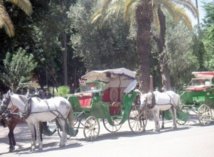
The horse-drawn carriage, an emblem of the ochre city

In the same way as the gondola is for Venice or the red imperial bus and black taxis are for London, the horse-drawn carriage has become an emblem of the ochre city and is now inseparable from the tourism sector of this city. Integrating into the urban landscape of Marrakech, the olive-green carriage has established itself, over time, as the most ecological and original means of transport to walk around and visit Marrakech, the thousand-year-old city with international tourist radiance and countless historical and natural sites. Marrakech is among the very few cities in the world that have known how to keep, and with care, the horse-drawn carriage as a "true intangible heritage", making this imperial city a magical place where modernity and authenticity coexist in perfect harmony. For the teacher-researcher specialising in heritage, Mohamed Oujamaâ, the familiar term widely used by Moroccans to designate this means of transport finds its origin in the term "cocher" (carriage driver). The introduction of the horse-drawn carriage to Morocco dates back to the 19th century, a period during which the foreign community, mainly English merchants settled in Morocco, adopted the carriage as a means of transport. Subsequently, it would be adopted by notables and high representatives of the authorities, he specifies. "The carriage was not only a means of transport but was also a symbol of social prestige," he notes. Later, the carriage was adopted by the popular classes as a means of transport and also served to transport goods to the bottom of the Souks, notably after the street development operations. This adoption was done according to local criteria, and by adapting the carriage to the specificities of the streets of Marrakech. Indeed, the European widths (1.80 to 2.00 metres) were replaced by others (1.40 m to 1.50 m) depending on the dimension of the streets of the ochre city at the time, he explained. If the horse-drawn carriage has disappeared from other Moroccan cities, replaced by new means of transport (coaches, buses, and cars among others), Marrakech has preserved this means of transport in the tourism sector, the flatness of the ochre city having dictated this orientation, according to Mr. Oujamaâ. Becoming today a must for visitors, both Moroccan and foreign, the horse-drawn carriage is a mobile memory of great added value for the tourism sector and at the service of the international radiance of Marrakech. To try to structure this sector, the public authorities have taken several measures. It is first of all a matter of subjecting the carriages of Marrakech to daily control: trust permits for drivers, condition of vehicles and horses. To facilitate this process, the carriages have electronic chips and serial numbers for the horses. Furthermore, the Society for the Protection of Animals and Nature (SPANA) organises competitions rewarding the most beautiful teams and mounts. The Secretary General of the Association of Carriage Professionals, Hassan Lakhdar, noted for his part that carriages are currently facing "unbalanced competition" with double-decker buses, which account for nearly 60% of the tourist ride market in Marrakech. Indeed, the company in charge of operating these double-decker buses offers rates that defy all competition, he observed.

Listen
Size:
