The level of precipitation in the Loukkos basin, which has not exceeded 250 mm since the beginning of this year, against an annual average of 700 mm, has pushed the parties concerned to attach particular importance to the rationalisation of irrigation water coming from the Oued El-Makhazine dam and the groundwater, in order to save the agricultural season and achieve optimal yield in relation to this difficult situation. But according to professionals, this situation is aggravated by other structural and organisational factors, preventing good use of water resources, not to mention the indebtedness of farmers to the Regional Office for Agricultural Development of the Loukkos (ORMVAL), which finds itself unable to pay the electricity bill necessary for the operation of irrigation equipment in the basin.
The basin's surface and groundwater resources are estimated at nearly one billion m3, including more than 700 million m3 at the Oued El-Makhazine dam, and nearly 90 million m3 that can be mobilised in the basin's groundwater.
A potential called to increase by nearly 480 million m3 more with the inauguration in 2014 of the new Dar Khrofa dam in the province of Larache. For the Regional Director of Agriculture, Mostafa Hassani, the Loukkos region is rich in hydraulic resources and fertile land, but this does not prevent strengthening initiatives for water rationalisation, particularly in such a climatic situation, in parallel with the various efforts carried out in partnership between farmers and the administration concerned for the optimisation of agricultural yield.
In a statement to the MAP agency, Mr. Hassani minimised the impact that the lack of precipitation would have on irrigated crops, stressing that the Oued El-Makhazine dam reservoir is 70% full, which is sufficient to meet the needs of the irrigated perimeter of the Loukkos basin for the current agricultural season as well as to prepare for the start of the next season. The farms falling within this perimeter, which covers more than 30,000 ha, consume between 200 and 300 million m3 of water per year.
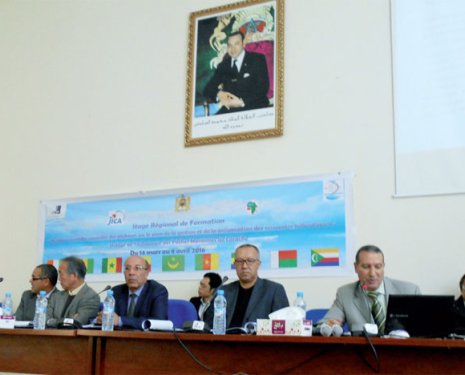
The president of the Loukkos Agricultural Chamber, Abdessalam El Biari, seems less optimistic concerning the current agricultural season which has been marked by low precipitation and a significant cold wave having affected large cultivated areas. During a recent communication meeting on this subject, held recently in Ksar El-Kébir on the occasion of World Water Day, Mr. El Biari called for the establishment of a special commission at the level of this agricultural basin, in charge of the Valorisation of irrigation water, demanding support for farmers for the current season. Representatives of farmers went further by asking, during this meeting, to declare the Loukkos basin a disaster area. Mr. El Biari, for his part, estimated that the situation is not yet worrying and that it was still possible to save the season with good use of water and greater adherence to support programmes for alternative crops.
The irrigation system of the Loukkos perimeter also faces the problem of farmers' indebtedness to the ORMVAL, which threatens to jeopardise the irrigation operation and the maintenance of equipment.
According to official data, farmers in the area owe the Office more than 194 million DH covering the costs of irrigation services during recent years, a substantial sum capable of allowing the modernisation and maintenance of the entire irrigation system. Farmers cite the difficult climatic conditions of this agricultural season and the lack of productivity to justify the non-payment of these fees.
Several managers of agricultural operations, particularly in sugar crops, state that the lack of precipitation and the cold wave have seriously affected production, which puts them in an inability to settle financial commitments towards the Office and suppliers of agricultural equipment. This situation does not fail to affect the ORMVAL which finds itself, in turn, unable to pay the electricity bill which has exceeded 60 million DH, in addition to maintenance costs, which amounted, for last year alone, to 36 million DH.
The indebtedness of farmers to the Regional Office for Agricultural Development of the Loukkos (ORMVAL) represents significant sums. The recovery of these debts is, according to the Office's officials, a necessary operation in order to guarantee the smooth running of an irrigation network counting 21 pumping stations, more than 600 km of canals, and more than 2,300 irrigation points. The Office's management, moreover, urges farmers to settle their debts to the Office so that it can continue to provide irrigation services, knowing that farmers benefit from a state subsidy on irrigation water consumption bills, covering more than half of the actual cost of the cubic metre, set at 1.2 DH.
Benchmarks-* The irrigation network in the Loukkos basin has 21 pumping stations, more than 600 km of canals, and more than 2,300 irrigation points.
-* Farmers in the area owe the Office more than 194 million DH covering the costs of irrigation services during recent years.
-* The farms falling within this perimeter, which covers more than 30,000 ha, consume between 200 and 300 million m3 of water per year.