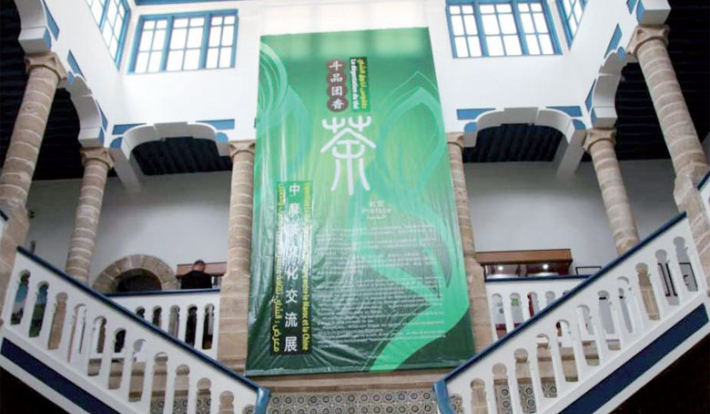
Due to its location as an Atlantic port that has seen various civilizations pass through over the centuries, having rubbed shoulders with the land and coasts of Morocco since the dawn of time, the city of Essaouira perfectly embodies the composite and ancient Moroccan civilization. This immense wealth is carefully preserved and presented to the general public within the Sidi Mohammed Ben Abdellah Museum in Essaouira.
This ethnographic museum, which has an archaeological section and is named after the founder of the city of Essaouira (mid-18th century), opened its doors for the first time on October 20, 1981, with the main vocation of translating the landscape and cultural richness of the Essaouira area by presenting a collection linked to various themes of tangible and intangible heritage.
A vocation that materializes through a carefully arranged museum circuit that makes optimal use of the building housing the museum, a merchant's house built in the 19th century in the Kasbah district.
It is clear that, thanks to its architectural characteristics, this stately home perfectly accommodates its new function, since these types of houses are generally very vast and are organized around a central courtyard, square or rectangular in shape, opening onto large rooms for commercial use (warehouses), with a floor reserved for the owner and his family and composed of rooms opening directly onto the gallery.
Thus, the ground floor of the museum sheds some light on the natural potential of the region, notably the two raw materials that make the city famous on a national, and even international, level, namely the argan tree and the thuya wood.
The ambulatory on the ground floor of the museum also allows for retracing some pages of the city's history from prehistoric, ancient (Phoenician, Mauretanian, Roman, and late Roman) and medieval times until the foundation of the current Medina in the mid-18th century, by Sultan Sidi Mohammad Ben Abdellah.
This succession of different civilizations is reflected through a collection of archaeological objects discovered in the various sites of the region, such as the Island of Mogador, Jbel Lahdid, Ida Ouazza, or Cap Sim, and by Roman coins and a dozen silver coins minted during the reign of the city's founding Sultan.
The architectural aspect that distinguishes the Medina of Essaouira from other Moroccan Medinas is also present in the museum through a series of old photos (in black and white) that invite one to stroll through the Medina and visit its most prestigious monuments.
The museum's upper floor offers an opportunity to grasp up close the cultural diversity that characterizes the city of Essaouira, as evidenced by the coexistence, from its foundation, of various cultures (Amazigh, Arab, and African) and faiths (Muslim, Christian, and Jewish). This diversity has resulted in a richness and osmosis of cultural and religious practices and the emergence of traditional trades and arts (jewelry, woodwork, tapestry). The floor is thus divided into several pavilions presenting a collection of ethnographic objects according to several themes, namely Quranic tablets, manuscripts, Jewish cult objects, traditional jewelry artworks, musical instruments, a collection of weapons, a panoply of costumes, thuya wood and painted wood artworks, and some models of carpets from the Essaouira region.
This vocation of the museum as a mirror of Moroccan civilization was consolidated after renovation work, undertaken recently with the aim of improving the museum circuit and strengthening the attractiveness of this establishment. This work concerns both the renovation of the historic building housing the museum, the reorganization of the museum circuit in a way that meets current standards in terms of exhibition, maintenance, and enhancement of objects, and the enrichment of the museum's collection.
Thus, the museum circuit has been equipped with surveillance cameras, lighting adapted to the fragility of the exhibited objects, and a sound system playing loops of pieces from the traditional musical repertoire, in addition to an attractive reception installation, designed by the Souiri artist Mohamed Mountassir. According to the museum curator, Ghita Rabouli, this work is part of the upgrading of this museum. For this, "we opted for a concept capable of improving the reception and reflecting an image worthy of the stature of this establishment," she affirms to the MAP.