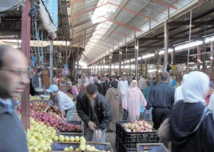
As soon as you cross the entrance, Souk Al Had of Agadir presents itself as an Ali Baba's cave where a myriad of sounds, smells, and colors swarm, thereby giving all its splendor to a singular place of attraction and shopping which, at the advent of each Ramadan, offers itself yet another rejuvenation.
Indeed, one could not visit the Moroccan south without coming to Agadir, and there, one could not resist the curiosity to see what this imposing ocher wall with the appearance of a Kasbah, which is called Souk Al Had, the largest urban Souk in Africa, which, throughout the month of Ramadan, offers itself a new facelift, hides hermetically, like a jewel.
The visit to this immense market, on the eve of the holy month, presents itself as an almost dreamlike dive into a buzzing hive of auctions and apostrophes, some praising beghrir, msamen, and other briouates, others offering plastic bags (mika darham, mika darham), others pushing with perfect mastery, along the narrow alleys, small carts with the recurring calls of "balak, balak".
"Beyond its sober aspect, this enclosure generates a turnover of more than a million dirhams per day," explains from the outset, in a statement to the MAP, Ahmed Tazad, head of the administration of the Souk Al Had Commercial Complex.
At the end of this pre-Ramadan day, the visitor only has to let themselves be rocked by the human flow which, like a groundswell, washes over this market, to the scent of ground coffee and spices where cumin, coriander (qozbor seeds), caraway, and cinnamon compete for the spotlight with the scents of anise, saffron, ginger, sesame seeds, and other paprika.
The first destination of attraction for national tourists in particular, with an increasingly growing influx of foreign visitors, this market, one of the most popular in Morocco and Africa, covers a covered area of nine hectares, resumes Mr. Tazad.
The Souk has more than 2,000 commercial premises and nearly 1,200 stalls, while the number of visitors fluctuates between 30,000 and 40,000 per day, to peak at more than 80,000 people during weekends and religious holidays, including the long days of Ramadan.
To the varied sounds, which resemble a true Tower of Babel, are added a profusion of colors and spectacles embellished, sometimes by the sight of bowls of honey of all kinds or argan and olive oils, sometimes by the dexterity and skill with which women apply themselves to making, on the spot, the essential Amlou (a typically Souss spread, made from argan oil and almonds).
Of all the spaces that this market covers, the fruit and vegetable stalls seem to be the most prized both for the friendliness of the merchants and for the layout, quality, and freshness of the products which, for the most part, come directly from the farms of Biougra, Houara, Massa, or even Khmiss Ait Amira. There is also a great rush at the dried fruit sellers where stalls, seemingly cramped, display impressive quantities of raisins, apricots, almonds, walnuts, and prunes, not to mention the packages of dates that soften before your eyes, or even at the fishmongers, butchers, and sellers of cereals and pulses. And that's not all. Here is Brahim, a tailor of traditional clothes, who assures that his order book has been closed for more than a month already and should be until after Aid Al Adha (end of September), while his neighbor, a passementerie maker, says he is "really overwhelmed by orders, even by calling on the services of two other mâallem".
Hamid, a young civil servant by profession, assures that he likes to go to the Souk daily, not to go shopping, a mission he leaves to his wife, but just for the pleasure of strolling along its shaded alleys, just to "kill time while waiting for the breaking of the fast".
"And then, you never know? Sometimes you can very well come across particularly interesting opportunities from street vendors: a watch, glasses, a mobile phone, an iPad, or other gadgets," he specifies, supporting his point with a wink, which says a lot about the type of "opportunities" he is looking to seize.
For Hajja Fatima, a sexagenarian who drags two young children behind her, the morning is the best time to do shopping at Souk Al Had during the month of Ramadan: "The merchants are available, the stalls are well-stocked with fresh products, and above all, there are not many people".
"You have to be careful, some offer you products that are not really beldi (local/authentic) at a high price, as is the case with sesame seeds imported from Egypt or Pakistan," she will say, before continuing with other practical advice regarding the choice and preservation of food or the making of dishes and other chhiwates for this blessed month.
"Initially, Souk Al Had was located in the Talborjt district before the 1960 earthquake. It was then transferred to the current industrial district before settling here at the beginning of the 90s in the form of a weekly market, hence its name, moreover," recalls for his part Haj Ahmed, a septuagenarian merchant of the place.
During its various wanderings, this market, which has suffered at least seven fires since 1990, the last of which dates back to July 2003, has offered itself a permanent facelift thanks to extension work that has brought its total area to nearly 13 ha.
Equipped with thirteen main entrances and two emergency exits, the Souk is equipped with a tax office, an annex of the local authority (khalifa), a post office, and a police station, including a tourist police unit, without forgetting the possible setting up of a branch of the Moroccan Red Crescent and a representation of the Civil Protection.
Regarding hygiene, many merchants have expressed the hope of seeing this structure equipped with a control unit, while at the Municipal Council, it is assured that a landfill for waste is already in place, knowing that the Souk is closed throughout the day on Monday for the cleaning of this commercial surface.
When leaving the Souk, the visitor does not really have to worry about having forgotten something in their shopping, since, along the alleys, mountains of chebbakias offer themselves to their gaze, and lines of sellers will remind them of briouates, baghrir, msamen, razet al qadi, and other semolina-based pancakes, not to mention the cart holders who offer, pell-mell, fresh cheeses, daily cakes, juices of all kinds, or even chickpeas soaked in water (an essential ingredient for Harira, the undisputed mistress of the Ramadan table) in case latecomers have forgotten to do so.
"Throughout this blessed month, no one is idle unless they want to be. Here, it's a permanent beehive and all day long, there is baraka (blessing)," will say with confidence Rachid, a young parking attendant between two whistles intended for his colleague, at the other end, to rush to collect his due from a motorist at the exit.
News 19 Jun 2015 6 min read
Anthology of colors, sounds, and scents at Souk Al Had of Agadir