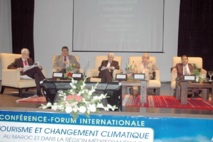
Under the aegis of the Ministry of Tourism, the Rural Tourism Development Network of Southern Morocco (RDTR) and Ibn Zohr University organised an International Conference-Forum in Agadir on 8 and 9 June 2012, under the theme "Tourism and Climate Change in Morocco and the Mediterranean Region: A Global Challenge, Local Solutions".
This conference-forum, whose opening ceremony was chaired by the Wali of the Souss-Massa-Drâa region, in the presence notably of the President of the Regional Council, the President of the Prefectural Council, and the MP-Mayor of the city, is part of a local desire to develop the search for solutions to the problem of tourism and climate change.
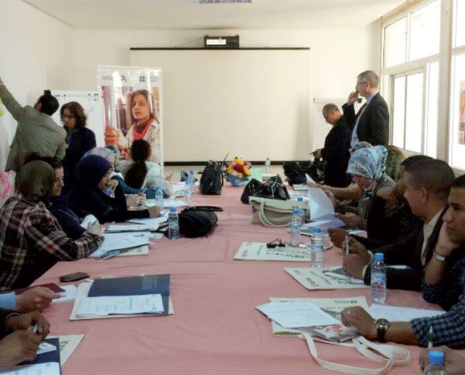
After addressing this problem in two plenary sessions, the participants then worked in workshops: workshops 1A and 2A: Sustainable Tourism and Climate Change; workshop 1B: Adaptation of the tourism offer to climate change.
It is worth noting the high quality of the interventions at this conference-forum, in which eminent national and international specialists took part.
Morocco is an interesting case due to its great geographical diversity (coast, mountain, oasis, desert...) and the vulnerability of its ecosystems.
And as stipulated by the "Davos Declaration", it is imperative to put in place a strategy aimed at reducing greenhouse gases (GHG) and measures for the implementation of sustainable tourism through institutional programmes aimed at making known, raising awareness, and encouraging tourism actors to consider the challenges of climate change as a true societal project.
It should be recalled that tourism is responsible for about 5% of global CO2 emissions, i.e., 4.6% of global warming. It is quite obvious that the transport sector is the most polluting since it constitutes 75% of GHG emissions attributable to tourism, and in particular air traffic. The hotel sector is responsible for nearly 20% of the sector's emissions due to air conditioning, heating, maintenance... According to the UNWTO, the increase in traveller flows could increase GHG emissions by 150% over the next three decades. Hence the need to take urgent concrete measures such as the implementation of environmental management.
With the rise of climate change, climate should no longer be at the centre of the choice of a tourist destination. The climate-tourism comfort index, which uses the main meteorological data of a given destination, is one of the key factors of motivation, and therefore of the purchasing decision of potential visitors. This index shows that above 31°C, the tourist's comfort begins to be called into question. Consequently, rising temperatures are not always synonymous with tourist satisfaction.
And among the other negative impacts of climate change that have direct or indirect implications on the present and future of tourism, we can cite: the rise in sea levels and the modification or even erosion of coastlines; the decline in water resources and supply difficulties; energy shortages; desertification, loss of forest areas, the retreat of snowy areas, and other landscape changes, hence the decrease in carbon sinks; threats hanging over biodiversity (a rise of 1.5 to 2.5 degrees would jeopardise 20 to 30% of fauna and flora worldwide); heatwaves and other large-scale natural disasters; the increase in health risks; the vulnerability of food security (rising costs and decreasing cultivable areas), the economic impact of which is estimated at 2 to 50 euros per tonne of carbon emitted.
Furthermore, climate change is modifying seasonal tourism models. The practices adopted by tourists in the coming years in parallel with this change will focus on new models not yet defined.
The Mediterranean represents 1.5% of the Earth's surface and is home to nearly 10% of the world's flora. Its high rate of biodiversity makes it particularly vulnerable to climatic hazards.
The Mediterranean coast, which includes 21 countries, is the most popular tourist destination in the world; it attracts 30% of tourist flows and world tourism revenues with a growth of 3 to 4% since 2000. Tourism has therefore become the primary source of foreign currency in this region.
In Morocco, climatic observations of the last decades highlight the development of desertification, the progression of the semi-arid climate towards the North of the Kingdom, water shortages, a weakened vegetation cover, a reduction in snowfall, impacts on agriculture, and the multiplication of fires. And in parallel with these changes, the frequency of storms in the Atlas now generates numerous floods.
As for greenhouse gas emissions, they were estimated at 75 million tonnes of CO2 equivalent in 2004, which represents 2.5 tonnes of CO2 equivalent per inhabitant per year. Numerous measures have been taken to mitigate these impacts, the objective being to bring this rate down to 52.9 million tonnes of CO2 equivalent per year by 2030. However, compared to other countries, Morocco emits few GHGs, but it remains vulnerable. Hence the need to develop mechanisms and techniques for adaptation and mitigation integrated into a global sustainable development policy.
Morocco has also favoured tourism and hotel environmental management, and in particular energy efficiency. This desire was reinforced in Vision 2020, where sustainable development is placed at the heart of the strategy.
Finally, it should be noted that this conference-forum is the first in Morocco to be placed under the banner: Carbon Neutral. This was translated in practice by a certain number of concrete measures taken at the organisational level in terms of energy, the making of work tools (badges and bags...), the travel of participants...
News 12 Jun 2012 5 min read
Agadir International Conference-Forum: Adapting the tourism offer to climate change