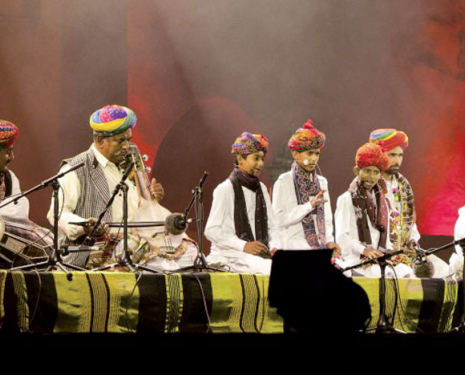
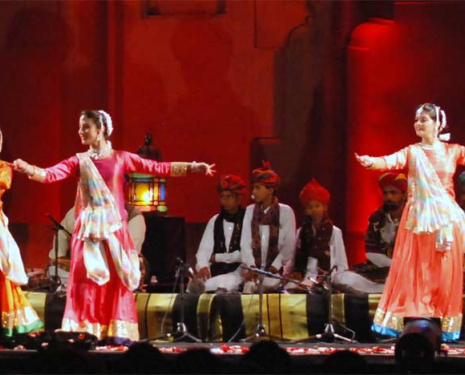
It is in the heart of the magnificent Jnane Sbil, the oldest garden in the city of Fez, that the twelfth National Festival of the Art of Malhoun opened on 25 April to the great delight of lovers of this ancestral art. The latter were not disappointed as they experienced an unforgettable evening marked by performances of great mastery, where "qsayed" drawn from the national poetic heritage are married to melodies that blend Arab-Andalusian and oriental scales to give an exceptional result. The art of Malhoun, which constitutes a part of the Moroccan cultural and artistic heritage, occupies, in fact, a privileged place in the hearts of Moroccans who, by listening to it, rediscover the simplicity of their daily life and the greatness of the history of their ancestors. This pleasure will last until 3 May, with orchestras, musicians, and "mounchidines" from the four corners of Morocco (Meknes, Tetouan, Erfoud, Marrakech, etc.). Honouring themes related to Moroccan society and religion, these artists will occupy the large squares, the Riads, and other places steeped in history in the spiritual capital of Morocco to host appealing shows and share their know-how and passion for traditional Moroccan music with the audience. Organised by the urban commune of Fez, the festival also includes local concerts at the Aïn Nokbi socio-cultural complex, theatrical plays inspired by Malhoun singing, cultural and spiritual visits to the mausoleums of the Medina, as well as conferences and training sessions around Malhoun, its history, its interpretation techniques, its figures, and its terminology, hosted by professionals Abdelouahab Filali and Abdelmajid Fennich. On the menu for this edition, dedicated to the theme "Malhoun and Handicrafts", there are also exhibitions of handicraft products at the Batha square and the Fez handicraft complex and a conference on the relationship of Moroccan artisans with Malhoun singing. A tribute will also be paid to the Fassi artist Mohamed Soussi for his significant contribution to the safeguarding and enrichment of the art of Malhoun. Discovering the grammar of Malhoun: Malhoun has its characteristics and its grammar, like all the poetry of the world. But each poet has his style of composition, but also his favourite subjects that preside over the construction of his poetic sentences, when speaking of society or feelings. It is a simple art in words and music. It contains images for the peasant as well as for the scholar. Everyone finds a reason for satisfaction in it. It takes its source from popular oral wisdom and also from literature and religion. Its language is close to that of the street; it borrows its simplicity, its sarcasm, but without vulgarity. Sarcasm is taken as a theatrical game in the art of pronunciation and singing.
Festival 29 Apr 2014 3 min read
Appealing artistic shows hosted by "mounchidines"