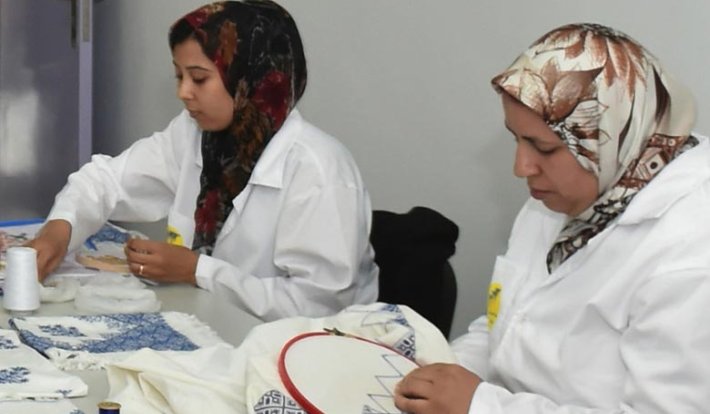
A call to strengthen the managerial skills of cooperatives and productive associations, encourage projects oriented towards the creation of SMEs, and integrate the social and solidarity economy into school curricula.
Participants at a study day, organised last weekend in the rural commune of Bzou (Azilal province), highlighted the significant contribution of the solidarity economy to rural development and its role in the fight against social exclusion, particularly in rural areas.
The various speakers at this meeting, initiated by the Moroccan Centre for Strategic Research and Policy Studies in partnership with the commune of Bzou, highlighted the role that now falls to the solidarity economy in terms of fighting precariousness and readjusting socio-economic and geographical imbalances, through the valorisation of human resources and the consideration of the gender approach and the territorial approach.
The participants, researchers and associative actors, emphasised the importance of prioritising the collective management of income-generating activities and setting up structures favourable to the emergence of social and solidarity economy projects, noting that this type of production has become complementary to national economies and a necessity for diversifying and developing modes of production.
This meeting was an opportunity to shed light on successful experiences in the field of management and production of a number of social and solidarity economy projects and cooperatives, the objective being to raise awareness of the roles played by this type of production in the fight against exclusion and precariousness and the achievement of development and social justice.
In this sense, they mentioned the experiences of the Office for the Development of Cooperation, the National Mutual Aid, and the Social Development Agency, noting the significant contribution of cooperatives operating in various sectors (agriculture, handicrafts, housing, local products...) to territorial development, job creation, and skills development, particularly in the rural world.
Returning to certain constraints suffered by the social and solidarity economy (lack of qualified human resources, deficit in know-how and management...), they called for strengthening the managerial skills of cooperatives and productive associations, encouraging projects oriented towards the creation of SMEs, and integrating the social and solidarity economy into school curricula.