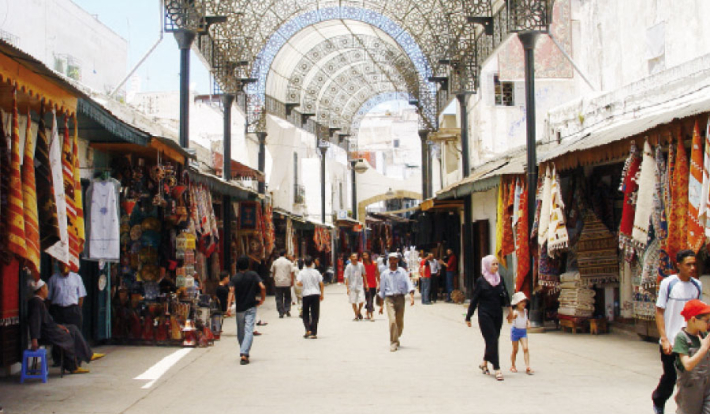
Rabat. Rue des Consuls. It is noon. Stalls of various sizes are scattered on either side of this historic alley partially penetrated by the rays of the sun. Multicoloured objects catch the eye: djellabas, pottery, babouches, etc., but what attracts attention are the carpets.
Once spread directly on the ground, these carpets are now preciously stored inside the stalls because of the street redevelopment work. Inside a shop, the smell of dust fills the atmosphere. A situation surely due to the time many carpets have remained without being sold.
"The sale of carpets is no longer working as before. The business is going from bad to worse. Today, I have trouble selling one piece a day as was customary," laments Noureddine, a 49-year-old seller present on the premises since 1993. Well settled in his bazaar while waiting for the rare customer, this merchant points the finger at the crisis. "It is above all the crisis that has worsened the situation. In the past, tourists were among our potential customers. But here, for a few years now, most of these foreigners only come to visit and take photos," he indicates.
However, this is not the opinion of this French tourist found on the premises. Accompanied by his wife Marianne, Charles explains that it is mainly for practical reasons that they cannot purchase certain items. "We often buy small-sized pieces. They are more practical and do not weigh very much. Which risks being difficult for transport on the plane," he defends himself, while acknowledging "the beauty and diversity of models offered by the Moroccan carpet".
On the other side of the street, a shop had just sold a medium-sized piece. The manager, a sexagenarian by the name of Benjelloune, less fatalistic, tempers the situation. "The carpet market is not dead. It has certainly experienced turmoil in recent years due to the crisis and the competition from carpets made by industries. But it survives until now," she retorts, not wanting to give more details about her income.
The Rabat carpet, although prized, costs more than the synthetic carpet manufactured in factories. Its price is up to 2 or 3 times higher than the imitated product.
A situation which, according to Mohammed, is explained by "the large number of women who work on the carpet and the time necessary (more than a month) to make it". These women, Ms. Benjelloune tells us, "are increasingly shunning the profession, discouraged by the arduous efforts made and the meagre income earned". "Which does not fail to influence the supply," she continues.
For a few months now, work has been undertaken to develop and make the old Rue des Consuls more attractive. "By making this alley narrower and less accessible with the noise of machines, dust, and odours caused, this work drives away customers, especially tourists," Haj tells us. Same tune for Mr. Aly who sees in this affair "a complication of an already critical situation". But, for his part, Noureddine considers that this work, once finished, will only improve the situation. "The street will be more attractive and tourists will certainly be more numerous," he adds.
The Rabat carpet has forged a reputation over time to become one of the essential products of Moroccan craftsmanship. Characterised by its symmetries, its floral motifs often accompanied by a medallion in the centre with different shapes, the "king of Moroccan carpets" is composed of two categories. A first called "Extra" carpet and another called "Superior". The first type, more expensive, is distinguished by the number of points that make up the weft. This can go up to 40 points per 10 centimetres. Its price is between 1,000 and 1,500 DH per square metre. The second, for its part, is recognised by its lower number of points (30 per 10 centimetres). It is made of cotton or wool and costs less than the first (about 500 DH per square metre). As for its history, when some say that Moors who came to settle on the banks of the Bouregreg brought it around the 17th century, others, more legendary, narrate that "one day, a stork dropped a piece of oriental carpet into the patio of a house", which would have inspired the women who made the Rabat carpet.
-* The carpets are preciously stored inside the stalls because of the street redevelopment work.
-* The sale of carpets is no longer working as before.