
FrançaisEnglishالعربيةDeutschEspañolNederlandsItaliano中文

Your cart is empty

Adventure awaits!

About Essaouira

Essaouira (/ˌɛsəˈwɪərə/ ESS-ə-WEER-ə; Arabic: الصويرة, romanized: aṣ-Ṣawīra), known until the 1960s as...

News in Essaouira

Follow the latest news, projects, and official announcements from your ville.

News 22 Jun 2013 3 min read

Essaouira vibrates to Ghiwano-Gnaoua rhythms

An atmosphere charged with emotions, nostalgia, and recognition reigned over the city of Essaouira on Friday during the second day of the Gnaoua and World Music Festival, marked by posthumous tributes to two renowned maâlems, namely Abderrahmane Paco and Abdallah Guinéa.
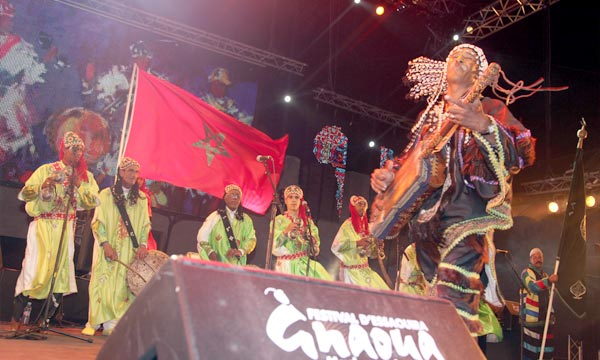
Essaouira vibrates to Ghiwano-Gnaoua rhythms

On the Moulay El Hassan stage, Gnaoua art rhymed with Ghiwani movement. And for good reason, the honour went to the one who succeeded in this impressive fusion between two currents as spiritual as they are committed, namely Abderrahmane Kirouche, alias Paco, who bowed out on 14 October 2012, at the age of 64. To pay tribute to the one who imprinted the Gnaoua soul onto Ghiwani song when he joined the legendary group Nass El Ghiwane in the 70s, there is nothing better than the Paco Ghiwane group, founded by the deceased ten years ago, accompanied by Moulay Tahar, a former member of Jil Jilala. They were accompanied by players of the alphorn, an imposing wind instrument used especially in Switzerland. It was enough then for the instruments to resonate to the Ghiwano-Gnaoua rhythms for the spirit of the 70s, which were the years of all follies, all extravagances, but above all of all commitments, to seize the thousands of festival-goers who came to bathe in this rare moment where the good old days "come back anyway". And many did not take long to sink into this state (hal) which combines exaltation, joy, and ecstasy, so that finally, music and body become one. It was also the moment to remember the Paco phenomenon in all its states, the "doctor of spirits" as Jimmy Hendrix nicknamed him: the love of music he had in his veins, the art and manner of transmitting this passion through the notes of the "guenbri" which he made speak like no one else, his singular interpretation and his voice, his talent, his charisma, his presence, his unbridled look, and his atypical clothes which made his performances pure spectacles. Another highlight of this evening was the fusion between Maâlem Mahmoud Guinéa, one of the emblematic figures of Gnaoua music, and Omar Sosa, a Cuban pianist inspired by traditional Cuban music, but also contemporary jazz, hip hop, and even Arabic music. Through their craft and their commitment, the two heavyweights - each in their own art - were able to establish a transatlantic link between two cultures of diametrically opposed origins: one drawing from the depths of the Sahara and the other coming straight from a Latin American culture. Earlier, in the Zaouia Sidna Bilal, it was Abdallah Guinéa, precociously in love with reggae, who was celebrated by Maâlem Mokhtar Guinea and Maâlem Boulhimas. Deceased last March, Abdallah Guinéa did not fall into the mystical world of the Gnaouas by chance, because this art remains a family affair among the Guinéas. Boubker Guinéa, Abdallah's father, was himself considered one of the greatest Maâlems in Morocco. At 12, Abdallah accompanied his father in nocturnal ceremonies, where he revealed prodigious gifts. He was then crowned master (Maâlem) at the age of 16. The cycle of recognition will continue on Saturday in the Zaouia Sidna Bilal, with a tribute to Maâlem Chérif Reguragui, a great lover of tagnaouite and a man of theatre, who will be honoured by the maâlems he knew: Seddik El Arch and Abdellah Akherraz.

Listen
Size:

