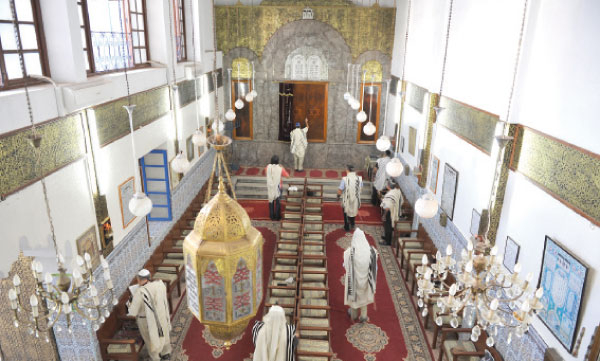
During her stays in Morocco, thanks to her meetings with many religious figures and intellectuals, and the support of her friends in Marrakech, Anne de Henning benefited from access to the places of worship of the three religions, which allowed her to document herself on rites and monuments.
One will discover in her photos: the Koutoubia, the Sufi brotherhood of the Zaouia of Sidi Bel Abbés, the most important of the seven patron saints of Marrakech, the morning prayer at the synagogue of the Mellah of Marrakech, the Sunday mass at the church of Essaouira, the vespers at the convent of the Melkite Eastern Catholic rite of Tazert. Also, the organisers of the exhibition explain that "the photographs of Anne de Henning bear witness to the history of Morocco as a place of meeting for the three monotheistic religions present today on its soil". A professional photographer since the 1970s, Anne de Henning began her career as a photojournalist in the Vietnam War. Attracted by extreme situations where man is confronted with himself, Anne de Henning was 23 years old when, in 1969, she took the Trans-Siberian and crossed the snowy Taiga to go and photograph the Vietnam War. At this stage, the event organisers indicate that the artist "based in Hong Kong, in love with freedom and adventure, travels through Southeast Asia. She crosses the China Sea in a junk to go to the Philippines, but, caught in the tail of a typhoon, the boat is dismasted, drifts, and coasts in the storm to Manila. In the Sulu archipelago infested with pirates and smugglers, she photographs the sea nomads. In Sarawak, she goes up the rivers in a dugout canoe to stay with the Dayaks in the heart of the Borneo jungle," they explained. It is therefore no surprise that her photos and articles will be published in major magazines in France and abroad such as "National Geographic", "Paris Match", "Le Monde", "Vogue", "Elle", "Bunte", "New York Times", or even "The Observer". In France, she favours working in "black and white" to photograph the "Bridges of Paris" from 1999 to 2005. Moreover, a selection of these photographs is today in the collections of the Carnavalet Museum in Paris and has been exhibited in Oman, Bahrain, Qatar, Dubai, as well as in the Palestinian Territories. In 2005, Anne de Henning undertook a report on women in the French Army, which took her to Djibouti via the Suez Canal and the Red Sea aboard a French Navy ship. It is, moreover, in this way that she discovered the Arabian Peninsula. She then decided, in 2006, to photograph the diversity of the countries of the region (Oman, Yemen, Bahrain, Qatar, Kuwait, United Arab Emirates) in their traditions and their modernity, while capturing the relationship maintained by the inhabitants with their urban living environment and their natural environment. Her work has been exhibited in galleries in Paris and Munich, among others. Her two photographic projects carried out in Yemen have, moreover, recently been awarded by the "Aga Khan Award for Architecture". A committed artist whose work is to be discovered...
Going beyond borders...
This is what is proposed to the visitors of this exhibition. The opportunity to probe the regions sometimes forgotten by the history of this country. A plural, tolerant Morocco where all religions can coexist in peace. This is in any case what these snapshots taken by a photographer artist who has long worked on the countries of the Arabian Peninsula before choosing to turn her lens towards Morocco suggest. And the result will be exhibited at the AFME from December until January 2013, just the time to go and discover another facet of this country whose history certainly has a lot to reveal...
-* This exhibition will take place from December 3, 2012, to January 6, 2013, in the heart of the French-Moroccan Alliance of Essaouira.
-* Anne de Henning benefited from access to the places of worship of the three religions, which allowed her to document herself on rites and monuments.
-* A professional photographer since the 1970s, Anne de Henning began her career as a photojournalist in the Vietnam War.