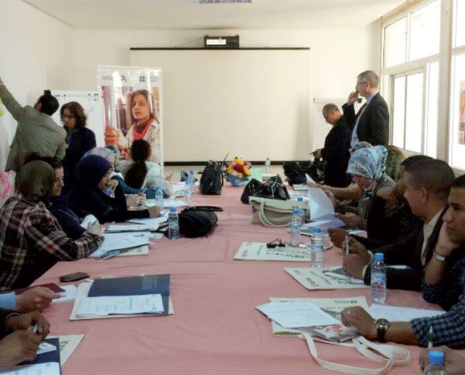
During the opening session of the conference-forum
tourism and climate
change, Tariq Kabbage spoke in his capacity as Mayor of Agadir, MP
of Agadir-Idaoutanane
and President of the Moroccan Association of Eco-Cities (AMEV). Here is the full text of this important speech.
"I would like to thank the Rural Tourism Development Network for organising this event on 'Tourism and Climate Change'.
Climate change is one of the issues that challenge the citizens of the world: What future for future generations? Will we have the intelligence to find solutions to the distressing questions of this millennium?
I am returning from a brief trip to France where I attended the screening of a film entitled "One Planet, One Civilisation, the Present and the Future". This film shows that under all climates, whether equatorial, semi-arid, mountainous, monsoon, oceanic, or polar, profound changes are taking place and will disrupt all lifestyles.
This visit also allowed me to discover a disaster-stricken region in the North of France, and in particular the city of Roubaix, which is undergoing a transformation thanks to the involvement of the elected officials of the Lille urban community and particularly a deputy to the president, from Maghrebian immigration and in charge of the environment. They have developed green spaces, restored life to nature, and allowed for the development of tourism in a region disfigured by wild industrialisation.
Man is capable of the worst, but he can also have the resources to restore what has been disfigured. If a region without assets manages to develop tourism, what can we say about our beautiful Idaoutanane region?
Our region is also threatened. After two years of devastating rains, our country is affected this year by a drought but also by cold spells accompanied by frost and, lately, devastating cherguis. It is a climate of extremes.
So, what future for our region, for its rural world, and in particular the Idaoutanane sub-region, a true treasure of biodiversity with more than 200 endemic species, including the argan tree, the Atlas pistachio, and species of euphorbia, in particular regis jubae, named after the king and botanist Juba II?
A region that holds potential for the development of sustainable tourism that we have not known how or have not wanted to develop. Tourism that could play a decisive role for populations that are deserting the countryside for an uncertain future in the city. Tourism based on this biodiversity in paradisiacal landscapes that the hippies of the 60s knew how to appreciate.
The state opted for these major strategies, Vision 2010 and Plan Azur, then Vision 2020 and latest-generation resorts. But for what result?
Taghazout, the resort planned since 1981, never finishes emerging from the ground. Every ten years, new versions are proposed. Two large golf courses are programmed, hotel lots of more than 10 ha with very few beds, villa zones, and RIPT, therefore real estate: 600 ha will be developed! Do we have enough water? Will the quantity of recycled water be sufficient? Which species will be planted? Who will be the investors?
We are facing pharaonic projects that will create few jobs in a region affected today by unemployment after having been, for years, a region that attracted thousands of citizens from all regions of the country.
Rural tourism, by involving local populations, young people who have succeeded at university, by training these survivors of our educational system, could allow for the creation of a formidable leverage effect. In European countries, mountain tourism is carried by the inhabitants themselves. They are the carriers of economic development. How would a mountaineer from the Alps react if he saw the best sites seized by groups foreign to his lands? What was the level of training of this mountaineer a little over 50 years ago?
The Taghazout tourism project itself must be rethought. A tourism project cannot be done outside of local populations. Villagers must be integrated.
We need an evolutionary project, in phases, and alongside these large "All inclusive" establishments, we must encourage another complementary product, different, for another clientele, for those who seek authenticity, a relationship with our culture, a relationship with nature.
Such a project requires the training of the mountaineers of Idaoutanane who have an innate wealth, namely the ability to welcome visitors.
During your two days, you will have to address varied themes. I am convinced that the participation of specialists in very different themes such as "Tourism Policy and Climate Change", "Tourism and Green Economy", "What Strategic Orientations for Sustainable Tourism?", "Eco-management in the Hotel Sector", etc., will allow you to identify new paths for responsible tourism, concerned about the environment and integrating local populations who possess traditions of hospitality and tolerance.
This tourism will be complementary to traditional tourism. I congratulate the Rural Tourism Network for its strengthening and expansion.
I wish you great success in your work for sustainable tourism, respectful of the environment, and which makes man the actor of change."
News 12 Jun 2012 4 min read
Tariq Kabbage, Mayor and MP of Agadir and President of the AMEV: "Idaoutanane holds potential for the development of sustainable tourism"