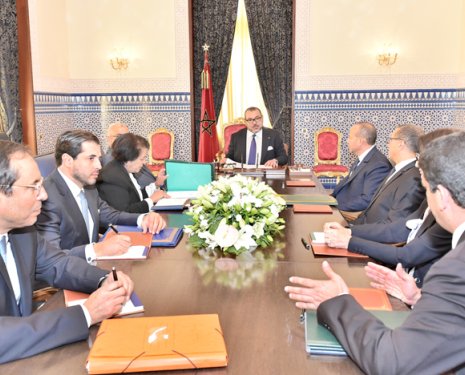
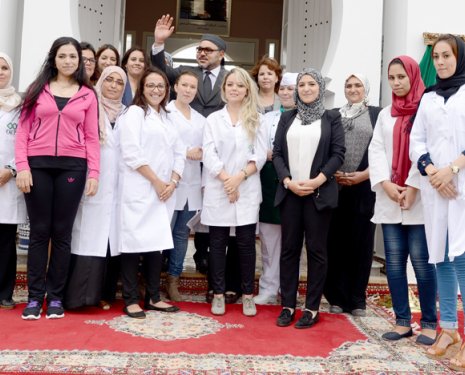
His Majesty King Mohammed VI, may God assist Him, inaugurated an Addictology Centre on Saturday in the Beni Makada district of Tangier, a new milestone in the implementation of the national programme to combat addictive behaviours, which has a total budget of more than 60 million dirhams (MDH).
Built by the Mohammed V Foundation for Solidarity for a total investment of 5.7 million dirhams (MDH), this Centre reflects the Royal High Solicitude towards young people and the Sovereign's determination to protect them from any deviance or social hazard and to create the necessary environment to encourage them to participate more fully in social life.
A privileged tool for care, awareness, diagnosis, prevention, and psycho-social support, the new centre is part of the national programme to combat addictive behaviours implemented under Royal High Instructions by the Mohammed V Foundation for Solidarity, in partnership with the Ministries of Health and the Interior.
This national programme aims to protect young people against the use of psychoactive substances, improve the quality of care for addicted persons, particularly drug users, increase accessibility to care structures, and encourage the involvement of civil society and social departments in addiction issues. It will also help these families to cope with the harmful consequences of addictive behaviours.
Like those built by the Foundation in Casablanca, Rabat, Oujda, Nador, Marrakech, and Tetouan, the Addictology Centre in Tangier will develop awareness and prevention actions against drug use, ensure medical and social care for people suffering from addictive behaviour, and work towards the effective involvement of families in prevention actions.
It also sets itself the objectives of social reintegration for the people concerned, as well as the supervision and training of associations in the field of risk reduction, particularly through the implementation and field support of young drug users and those at risk of addiction.
The Centre, whose construction work was launched by H.M. the King on 3 August 2013, was built on a state-owned plot of 3,800 m2 and includes a social support and risk reduction centre housing a conviviality space, a library-reading room, a multi-purpose room (projection, plastic arts, music), a computer room, a sports room, and an office for associations.
This centre also includes a mobile unit office that provides outreach interventions for drug users, missions for making contact, information, risk awareness, provision of prevention means, and orientation towards treatment centres.
This new structure also houses a medical centre that includes treatment rooms, consultation rooms for general medicine, addictology, psychology, psychiatry, an office for group psychotherapy, four rooms for methadone users, and a pharmacy.
The result of a partnership between the Mohammed V Foundation for Solidarity and the Ministry of Health, the Tangier Addictology Centre will be managed by the Ministry of Health and the National Association for Drug Risk Reduction.
On this occasion, His Majesty King Mohammed VI, may God assist Him, presented support cheques totalling 1.67 million dirhams to the associations that contribute to the management of the centres for the care of young people suffering from addictive behaviour. These subsidies are part of the support programme for the activities of the Addictology Centres (2014-2015), led by the Mohammed V Foundation for Solidarity and intended to support the programmes of the social support and risk reduction centres in Rabat, Oujda, Nador, Marrakech, Tetouan, and Tangier.
The Sovereign also presented an ambulance, a gift from the Mohammed V Foundation for Solidarity, to the Tangier Addictology Centre.
It should be noted that nearly 10,000 people were able to benefit from the services of the various operational addictology centres during the 2014-2015 period. Their network is expected to be strengthened thanks to the upcoming opening of an addictology centre in Fez and the construction of centres in Meknes (in the tender phase), Agadir, Al Hoceima, and Chefchaouen.