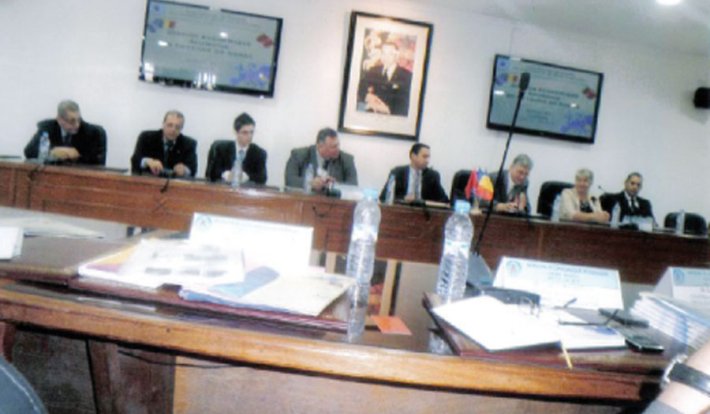
Within the framework of the revitalization of economic relations and partnership between Morocco and Romania, a delegation of about thirty Romanian businessmen, led by the head of the Africa Department at the Romanian Ministry of Economy, Trade and Business Environment, George Catineanu, was welcomed by the director of the Chamber of Commerce, Industry and Services of the Tangier wilaya (CCIST), Mohamed Bachir Mehdi, and Tangier businessmen. The director of the CCIST recalled the good relations that unite the two brotherly and friendly countries. Moad Idrissi, vice-director of the Chamber, for his part thanked Romania for the interest it shows in the region. He recalled the 50 years of diplomatic relations that unite Romania and the Kingdom of Morocco. "Contacts between our two countries have been established periodically at the governmental, parliamentary, and institutional levels," he specified, emphasizing that the cooperation and partnership relations between the two countries have never reached such a good level, thanks to the status that the two countries have in the region, Romania being a member country of the European Union, while Morocco is a privileged partner of the Union." Morocco, he added, constitutes, indeed, thanks to its geostrategic situation as well as the dynamism and stability of its economy, a privileged destination for exports and foreign investments, from which the country must benefit.
It should be noted that cooperation between Morocco and Romania embraces diverse fields, ranging from major education and vocational training projects, maritime port development, infrastructure, mineral and hydrocarbon prospecting, to mechanical construction and information technology.
Morocco is Romania's leading African partner. Moroccan exports to this country consist mainly of phosphates (more than 90%), canned fish and vegetables, citrus fruits, footwear, and textile products. In return, Morocco imports from Romania Dacia Logan car components (in CKD), chemical and metallurgical products, sanitary ware, synthetic yarns and fibres, bearings, machines, appliances and electrical equipment, optical instruments and apparatus, glass articles, paper and cardboard, cereals, agri-food products, and wood.
The president of the CCIST recalled that this economic cooperation between the two countries nevertheless remained very limited. "Trade exchanges have recorded a clear regression in recent years.
To remedy this situation, the businessmen of our two countries must promote economic and commercial relations and concentrate their activities in the areas of strengthening leadership capacities in vital sectors," he recommended.
Mohamed Mehdi finally expressed his great satisfaction with the relations of fruitful cooperation, mutual respect, and active solidarity between the two countries and expressed his determination to consolidate relations between Moroccan companies and their Romanian counterparts with a view to broadening their cooperation perspectives in the service of common interests. "I hope," he declared, "that they will be able to seize the opportunities and take advantage of the investment potential that the city of Tangier abounds with and further develop their commercial relations in the fields of automotive and naval construction, the chemical and parachemical industry, agri-food, textiles, tourism, health, leather goods, oil and energy, the pharmaceutical industry, agriculture, and waste management."
Romania and the external market
On 1 January 2007, Romania became a member state of the European Union. This accession opened up enormous possibilities for the future for all Romanian citizens, local communities, companies, and institutions, and for all of Romania's economic partners. The Romanian government wishes to stimulate companies and push them to rethink the way they approach external markets to market quality products and their own brands. At the end of 2011, Romanian exports amounted to 45.02 billion euros and imports totalled 54.74 billion euros.