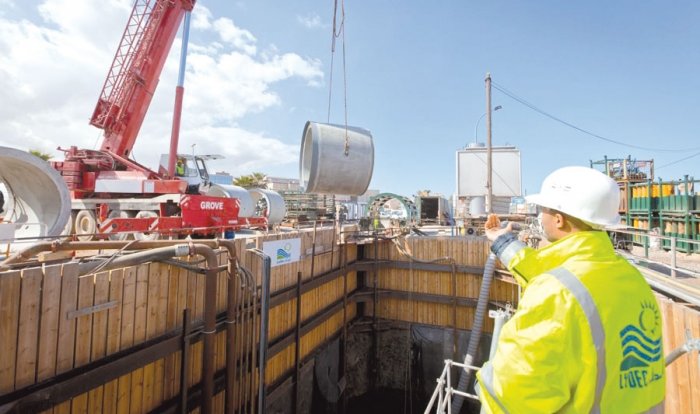
Launched in 2011, it is one of the largest projects currently being carried out in Casablanca. It is a project for the decontamination of the city's east coast. Basically, it is a huge pipeline with a diameter of 2.5 metres and a length of 24 km. Crossing the coast from the port and winding more than 10 metres deep to Mohammedia, this project complements the already operational system for protecting the beaches of the Corniche. With a beneficial environmental scope and a budget of 1.7 billion DH, the project represents the largest investment made by Lydec.
"The planned works aim to intercept the existing direct discharges of wastewater located between the port of Casablanca and Mohammedia, to pre-treat them, and to discharge them through a marine outfall. This system is already working successfully for the western part of the city, whose wastewater is intercepted and pre-treated at the El Hank station, which has allowed the Blue Flag to be obtained for the Aïn Diab beach," it is indicated at Lydec.
The project currently under construction should be operational in 2014. It will make it possible to gather in a single point the nine listed wastewater discharges, which are currently dumped raw directly onto the beaches. The project also consists of two coastal interceptors with diameters varying between 0.9 and 2.5 m. Similarly, it includes several pumping stations of different capacities, which can go up to 3 m3/s. The wastewater from Casablanca and Mohammedia will then be directed to a pre-treatment station. Equipped with a sand and grease removal system and a maximum capacity of 11 m3/s, this will be set up in Sidi Bernoussi, near the industrial zone. The pre-treated water will subsequently travel through a marine outfall more than 2 km long, at a depth of 20 m below sea level. The project is also subdivided into 3 geographical sections, comprising a total of 10 work lots.
"The anti-pollution project for the coastline aims to preserve the environment, the coastal ecosystem, and public hygiene. It aims in particular to protect the population and the coastline of the eastern sector of Casablanca from liquid pollution due to raw wastewater discharges, particularly those from industries. It will also make it possible to improve the living environment of the inhabitants, to revalue and embellish the maritime facade, as well as to have clean beaches, to contribute to their labelling, and thus to restore the tourist potential of the area," it is concluded.
The implementation of the decontamination project is being carried out using state-of-the-art technology. It involves a tunnel boring machine, a remote-controlled excavator that digs the galleries in sections of 600 m on average. This process eliminates all kinds of risks, since during the digging, no person is on the site at depth.
"The use of micro-tunnel boring machines for the excavation of the 'port' section gallery is a first in Morocco. These automated devices are placed at the desired depth, inside the access shafts. They dig the planned galleries without having to make open trenches or mobilise a team underground to supervise the excavation work. While respecting the environment, this method ensures greater safety, offers an undeniable time saving, and causes less inconvenience to local residents and users of the public highway," it is emphasised at Lydec.