FrançaisEnglishالعربيةDeutschEspañolNederlandsItaliano中文

Your cart is empty

Adventure awaits!

About Agdal Riyad

Agdal Riyad is a Moroccan urban commune in the prefecture of Rabat, in the Rabat-Salé-Zemmour-Zaër region.
It has a total...

News in Agdal Riyad

Follow the latest news, projects, and official announcements from your commune.

News 05 Jan 2012 4 min read

Mohammed V University: The Faculty of Letters of Rabat-Agdal opens up to the media

Mohammed V University: The Faculty of Letters of Rabat-Agdal opens up to the media

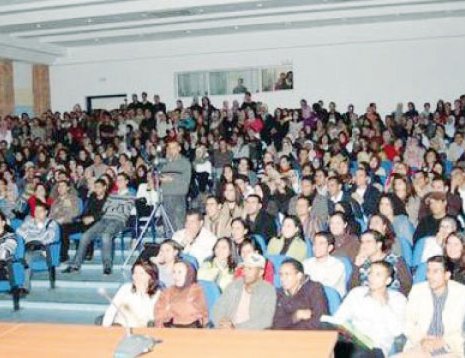
Mohammed V University is making eyes at the press. It must be said that it took a long time to undertake such an initiative. It is the Faculty of Letters and Human Sciences of Rabat-Agdal that dared to take the step towards the media. Is it out of modesty that it has not done so until now? And yet, it has everything to gain given the riches that its enclosure contains and that it should better share with others. Having been in a way the matrix of the other establishments of letters and human sciences, it enjoys a privileged place. And it is the dean of the Faculty, Abderrahim Benhada himself, who took it upon himself, before a group of journalists, to unveil the riches of his institution.

Admittedly, talking about such an institution is not easy given the multitude of fields it has served for years. Indeed, the said Faculty, as the dean explained, finds its origin in the Institute of Advanced Moroccan Studies established in 1919 by the French Protectorate. Since then and over the years, the Faculty has contributed to research and the training of high-level executives. But it goes without saying that the library remains the flagship building of the Faculty due to the diversity of its content. "It is a legacy that has been transmitted to us since the Protectorate. As a result, the library is rich in a very rare documentary fund, manuscripts, lithographs, and maps," declared Mr. Bendaha, while specifying that it occupies the third rank at the national level after the National Library and the Al Saoud Foundation for Islamic Studies. "To allow it to keep its rank, a budget of 250,000 DH per year is devoted to the purchase of new works. Not counting the books offered free of charge or within the framework of exchanges that come to garnish the library shelves," he comments.

Such jewels require a lot of attention and protection. In order to preserve the old editions against the devastating effect of time, new bindings have been applied to them. 16,900 works have thus been bound. The risks of loss and theft are quite evident, which implied a security system as explained by Mr. Benhada. The manuscripts are not left out. The library has 720 of them, which is the largest number existing at the university level. Suffering from a very advanced state of deterioration, many efforts have been deployed to restore and preserve them. It was also necessary to resort to a numbering system.

In order to contribute to the richness of this library, among others, the Faculty has invested a lot in the publishing sector and thus plays a very important role. From 1964 to 2008 and with the help of the Konrad Adenauer Foundation, 360 works were published, as explained by the dean. Subsequently, thanks to the participation of other partners, the Faculty had 68 editions to its credit (2009-2011). A way to also impose its presence at the international level.

Providing high-performance training has always been the primary concern of the managers. This is how the idea of creating a certain number of centres took its path. This is the case of the Language Centre, which ensures the upgrading of students in the matter. Certifications are issued to them. Even civil servants can have access to it at competitive prices. Another Centre is dedicated to studies and research in contemporary History. Which constitutes a certain originality. Sahrawi research and studies are not left out since a Centre is also devoted to them.

Furthermore, the Faculty is preparing to celebrate the centenary of the capital. On this subject, the dean affirmed that "a whole programme has been planned throughout the year 2012." The re-edition of certain works published during the occupation is at the heart of the event. These include "The Little History of Rabat" or "Rabat and its Region," among others. An exhibition of photos of the capital is also planned as well as the production of a map relating to it, and this, with the participation of other partners, Mr. Benhada did not fail to specify.

Listen
Size: