After several years of collaboration between the urban commune of Agadir and Nantes Métropole, the Franco-Moroccan cooperation in the field of urban transport has experienced a new momentum with the recent launch of the feasibility study for a High-Level Service Bus in Agadir.
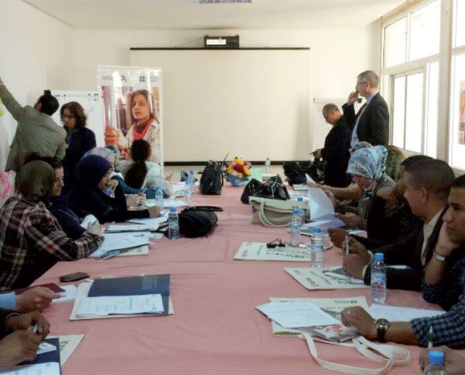
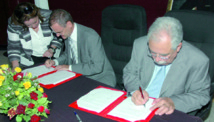
Indeed, a memorandum of understanding relating to the realisation of this study was signed between the urban commune of Agadir and the engineering firm SCE SAS of Nantes, in the presence, notably, of the Wali of the Souss-Massa-Drâa region, governor of the Agadir Idaoutanane prefecture, the representative of the French embassy in Morocco, the French consul general in Agadir, members of the Nantes delegation, members of the Municipal Council and executives and technicians of the urban commune of Agadir.
The High-Level Service Bus (BHNS) is a new concept of public transport adapted to the challenges of 21st-century cities: speed, reliability, safety and user comfort, without forgetting, of course, the protection of the environment. Unlike traditional buses, the BHNS has, for the majority of its route, an independent traffic lane equipped with its own signalling system giving it priority at intersections, which frees it from the hazards of city traffic and allows it frequent, fast and regular circulation throughout its journey. And in addition, the development of stations and the provision of specific rolling stock make it possible to ensure real-time information on passage times, good accessibility to buses, including for people with reduced mobility, as well as increased comfort and safety for passengers both at stops and in the vehicles. Similar to those of the tramway, but with much lower investment and operating costs, these performances make it possible to effectively replace the use of the car, and to considerably reduce the nuisances linked to this personal means of transport (noise, air pollution, traffic jams).
The realisation of a BHNS in the Agadir agglomeration was envisaged in 2011 at the initiative of the urban commune of Agadir, not only to improve traffic in the agglomeration by decongesting the city centre, but also to support the long-term development and growth of the city, particularly to the south and east. With a length of approximately 13 km, the route under study would thus serve economic hubs (port, city centre), the new city sector, and the university centre. Furthermore, extensions are envisaged towards the high-development zones of Hay Mohammadi and Tikiouine.
With a duration of 14 months and a total amount of €1,069,680, the feasibility study for this project benefits from double funding: the French embassy contributes to the mobilisation of experts from three French engineering companies (SCE, SAFEGE, CERYX) through a donation of €689,480 and the urban commune of Agadir is responsible, for its part, for mobilising 11 experts essentially from its technical services, for carrying out the measurement and survey campaigns necessary for the project, and for facilitating administrative and logistical procedures, for a total valuation of €380,200. It will be supported in this sense by the elected officials and technicians of the Nantes agglomeration, who wished to continue the decentralised cooperation programme implemented for several years already.
The feasibility study will take place in two phases. The first six months will be devoted to an exhaustive diagnosis of the current transport situation in Agadir, to the overall design and to the determination of the precise operational objectives of the project. The following eight months will see the realisation of the technical, socio-economic, financial, environmental and institutional studies which will allow, before the end of 2013, the presentation of the project to international donors, including the World Bank and the French Development Agency, which have already expressed an interest in their contribution to the financing of its realisation.
, mayor of the city of Agadir: "The memorandum of understanding that we have just signed today aims at the realisation of the study for a High-Level Service Bus project concerning a structuring axis in its own right-of-way that will connect the fishing port to Tikiouine. This project will be realised in several stages. The study aims at feasibility at the level of the axis that has been chosen, and which connects employment basins to places of life. It is therefore a large structuring axis that fits into our vision of quality urban transport with a high level of service.
This project is all the more relevant when we know today the crisis that populations in Morocco are experiencing in general regarding transport and travel. So it fits into our vision of travel which is a matter that concerns elected officials first and foremost.
This study will therefore allow us to have the detailed project of this site both on the technical level and that of its functionality. It is a work that will take about 14 months and at the end of which, we will be able to engage, at that moment, the contracts to realise this site. We also wish to have funding because it is an investment that is still relatively heavy.
In Nantes, they call it the busway, it's a bit like a tramway on tyres with, of course, a priority that allows for shortening travel times."
, elected official in charge of decentralised cooperation at Nantes Métropole: "The High-Level Service Bus is a project that is part of a whole programme that has been going on for years.
The cooperation in the field of transport between Nantes Métropole and Agadir began with contacts in 2001. Between 2007 and 2009, there was work with the decentralisation support programme with the PAD of Agadir. And since last year, there has been the signing of an agreement between Agadir and Nantes Métropole on this work, namely, the creation of a High-Level Service Bus line. And today, we witnessed the signing of the memorandum of understanding with SCE to launch all the studies that will allow for the implementation of this High-Level Service Bus.
There has already been work between the technicians of Nantes Métropole, the technicians of SEMITAN, which is the transport company of the Nantes agglomeration, to prepare the preliminary project. Now all this will be refined by specialised engineering firms. Nantes Métropole provides above all support for project management to the urban commune of Agadir, both through transport technicians from Nantes Métropole and SEMITAN who will remain very involved and who have created very strong links with the technicians of Agadir."