

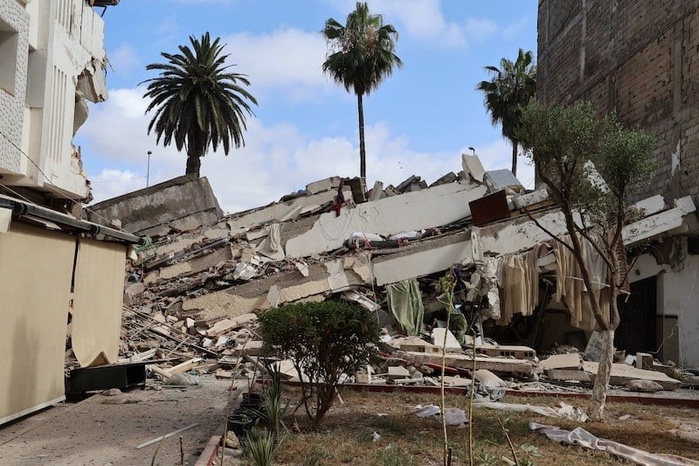
A few days ago, Casablanca woke up in shock. In the Mers Sultan district, a building partially collapsed in the middle of the night, causing widespread panic among the residents. The side facade of the roof collapsed abruptly, completely blocking alley 33 with rubble and damaging neighbouring homes. If the accident did not cause any casualties, it is only because it occurred outside of peak hours. A stroke of luck in this district, which is very busy during the day, particularly for its many ready-to-wear shops.
Initial findings point to the recent heavy rains as a triggering factor. But they are not enough to explain the collapse on their own. In Mers Sultan, as in other districts of the metropolis, the dilapidation of buildings is a chronic problem. According to the district authorities, more than 1,100 buildings have already been subject to decisions for partial or total demolition or reinforcement work, pending the intervention of approved experts. In Casablanca, more than 5,000 buildings are considered to be threatening to collapse.
This state of fragility is largely explained by the traditional construction techniques used in the 1950s and 1960s, often on the fringes of standards and without rigorous supervision. The anarchic constructions resulting from this era are today at the origin of a black series of collapses, for which Mers Sultan has been paying a heavy price for several years.
While emergency interventions by security authorities are systematic with each collapse, the underlying problem remains. The district council warns in particular about the great shortage of replacement housing, which hinders demolition operations for buildings identified as dangerous.
The regulations are, however, clear. According to the code in force, a building threatening to collapse is defined as any construction whose state may affect the safety of its occupants, passers-by, or surrounding structures. The responsibility for its maintenance lies with the owners, whether private or public. In the event of danger, they are required to take urgent measures to stop the risk, under penalty of being held liable.
An official from the Municipal Council specifies: "When a construction threatens to collapse, the owner or operator must take the necessary and urgent measures to stop the danger". If the building is rented, the law even authorises, in the event of proven danger, the termination of the lease and the evacuation of tenants without compensation, by court decision.
But on the ground, the implementation of these provisions faces a complex reality: many owners are absent, insolvent, or reluctant to undertake costly work. As for the residents, they live every day with the fear that the roof will fall on their heads.
Rethinking rehousing policies
The Mers Sultan episode serves as a reminder of the urgency of massive urban renovation in Casablanca, as it is a question of deeply rethinking the management policies for the old buildings of the Metropolis. The rehabilitation of degraded districts, often left on the margins of major urban modernisation projects, must become a strategic priority. This implies not only the demolition of the most dangerous structures, but also reconstruction in compliance with current safety and urban planning standards, the restoration of heritage buildings, and the improvement of basic infrastructure: roads, sanitation, public lighting. Because behind every building threatening to collapse, there are entire families living in fear, without any rehousing alternative.
