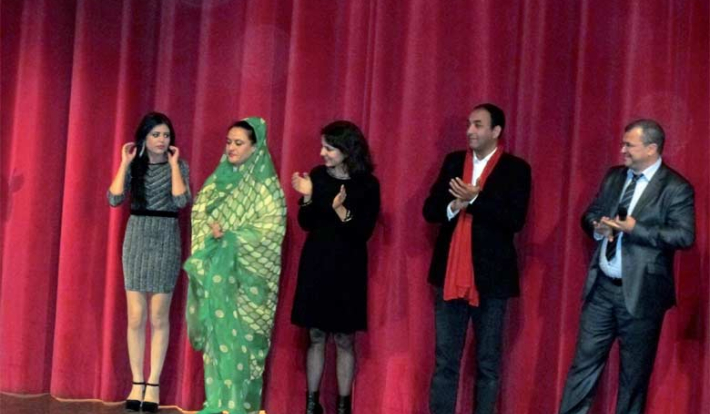
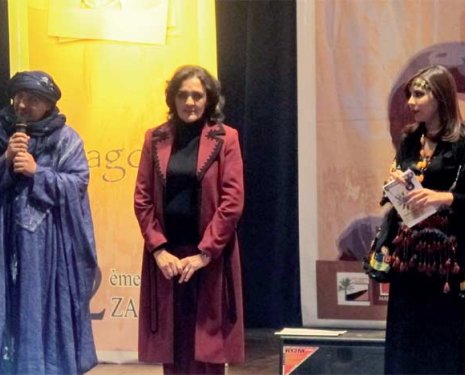
Eight productions are in the running for the grand prize of this twelfth edition of the Trans-Saharan International Film Festival, coming from several Arab countries.
These are Iraq, Bahrain, Jordan, the United Arab Emirates, Tunisia, Yemen, Egypt and Morocco. The latter was presented by the film "The Tears of Satan", shot in Zagora and presented in premiere at the festival. A beautiful coincidence that honoured this city and its inhabitants. Especially since the film pleased the festival-goers, as much by the theme chosen by its director Hicham El Jebbari, as by the actors, known for their talent and professionalism, notably Rachid El Ouali, Ismail Abou Kanater, Amal Ayouch and Younès Mégri. The latter played the main roles in the story of a political prisoner teacher who, upon leaving after eighteen years in prison, wanted to take revenge on his tormentor. "The script for this film was born from a fact I experienced when I was still in primary school where one day police officers came to forcibly take our teacher in the middle of class. An event that remained engraved in my memory.
It was the trigger for my script which I was able to finish after doing research by consulting files and reports concerning this period of our history. It was necessary to ask questions to different prisoners of this period to know more about their behaviour and their reactions upon leaving prison. Of course, this revenge side is pure fiction that I created to manage a personal ending and to say that if the facts happened in this way, many close people were affected by it," explains the director who took the public on a journey that evolves from fear and violence towards forgiveness and reconciliation. In parallel with the screenings of the films in the official competition, those of the panorama and the night of short films, other activities took place on the sidelines of the festival, including the visit of directors and actors to the Zagora penitentiary institution.
What can you tell us about your role as a political prisoner in Hicham El Jebbari's film, especially since it is different from what you have played before? Is it a plus in your career?
Yes, this role constitutes an added value in my career. It is first of all a very different and new role compared to what I have already done in substance and form. And this, through the violence that I have never personified. Because, as you have noticed, the character suffered for eighteen years of detention and decided upon leaving prison to take revenge. Then, I find that it is a role that fits well with my age.
What is also good is the fact of working with a director who loves his actors. This experience is a new launch for me for other roles that are just as different and complex.
What is the secret of this trust that you, and other well-known actors, have placed in a director in his first feature film?
We, as Moroccans, do not take into consideration the fact that we are celebrities to work with a director at his beginnings. It is a very normal thing for us.
I myself have already participated in several short films by young directors without being paid. I consider this as support for this young person who may one day become a very well-known filmmaker. For Hicham, I know him as a theatre director, I worked with him in a sitcom and I encouraged him to get into directing, because I saw in him a person who can give more to cinema thanks to his new vision. Then, he is someone who is passionate about cinema.
The Zagora Festival is in its twelfth edition. But, it has not yet been able to solve the problem of the screening room. A very important thing for a film festival...
First, it must be testified that this festival benefits from a very interesting theme, due to its geographical location. It is true that this room problem was the cause that did not encourage me to return after the first editions. Because, I did not want to present my film in a room that does not respect the professional standards of cinema.
It is unfortunate, as you have noticed, to see yesterday's film, in the presence of a beautiful world, in the unfavourable conditions of the screening room. Which undoubtedly shocked the director. I hope that the organisers will work on this point in particular because it is very important.
Can you tell us about your new projects?
I have just finished shooting a new film "Noah Can't Swim". It is my own production which cost me a fairly substantial budget. The story, taking place in the 50s, evokes the questions of disability and incest. We are in the editing phase of the film and I hope to present it to the public next year.