
The valorisation of the tourist, agricultural, and cultural riches of the regions constituted the background of the debates in Taroudant. The fair organised for this purpose made it possible to debate, from November 15 to 18, the development of the hinterlands. The central role of local associations and the very definition of the concept of "hinterland" were at the centre of the debates. Wearing his hat as president of the Provincial Council of Taroudant, Abdessamad Kayouh, also Minister of Handicrafts, took the construction of roads as an example to illustrate the partnership with local associations: "This project does not fall into any national road programme, it is an initiative of the local population," indicated Abdessamad Kayouh. As for the president of the Sous-Massa-Drâa region, Brahim Hafidi, he specified that 80% of the wealth generated by this region is concentrated in Agadir and Taroudant, which represent only 9% of the territory. The question of rebalancing then arises: "The reflection has been engaged since 2004 and is based on traditional agriculture and tourism." The argan tree, the date palm, the prickly pear, saffron, M'gouna roses, and honey are the targeted products and for which a support fund, endowed with nine million dirhams, has been mobilised: "This fund will be used to finance 57 projects spread across all provinces. The goal is to manage to mobilise 54 million DH in order to create 464 full-time jobs," indicated Brahim Hafidi, who specified that 15 million DH have been mobilised for tourism.
What definition to give to "hinterlands"?Beyond the various projects completed or in the process of being so, Mustapha Al Moutawakil, president of the urban commune of Taroudant, for his part asked himself: "Why do isolated regions not benefit from the riches they themselves generate for the benefit of large urban centres?"
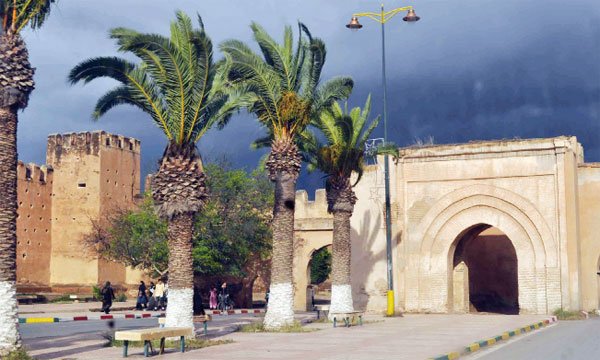
On this subject, the local elected official questions the concept of "hinterland". He will say in this regard that Taroudant, which was one of the capitals of Morocco, is still qualified as a hinterland. This questioning was widely shared by the audience.
According to Mustapha Al Moutawakil, this way of considering the regions favours the strong centralisation of the decision which "remains in Rabat". To support his assertions, the elected official cited the project to create an iron recycling plant planned in Taroudant. "This project, led in partnership with an Indian company and approved locally, would create 500 direct jobs and 2,000 indirect ones. The land base of 50 hectares has been cleared. However, and because the amount of the project exceeds 20 billion centimes, the file has been sent to the investment commission chaired by the Head of Government. It has been three months since we have been waiting to present our project to him."
During the inauguration of this fair, Abdssamad Kayouh had expressed the wish to see the establishment of an independent observatory whose mission would be to federate all the sectors concerned by the opening up and development of the regions.
Questions to: Abdessamad Kayouh, president of the Provincial Council of Taroudant"Partnership with associations is our asset"What are the particularities of the development projects of the province of Taroudant?
The particularity can be summed up in one word, it is partnership. All the major infrastructure projects in Taroudant have been carried out within the framework of partnership with associations. For example, the road programme currently under construction of 120 kilometres which concerns thirteen communes, the associations participate in it up to six million dirhams which will be raised thanks to the contributions of citizens which are made from ten dirhams. It is a particularity that will have to be extended to other regions, because the State cannot do everything all by itself.
During the debate on the "Development of the hinterlands of the Sous-Massa-Drâa region", there was talk of a centralisation of the decision that would hinder the development of the regions. Do you share this point of view?It is not entirely true, because decentralisation is underway in consultation with the communes and local elected officials of each region. It is they who, ultimately, decide what they want to do within the framework of central and regional programmes. It is time to work within a framework of partnership. Some regions have understood this, like the Sous-Massa-Drâa region. There is no other way, because we must already prepare for advanced regionalisation.
What would be, in your opinion, the means to federate the potentialities of the different sectors that intervene in the growth of isolated regions?The presence at this Fair of the Ministries of Handicrafts, Tourism, and Agriculture is likely to allow identifying the points of convergence between the different government programmes for the development of the hinterlands in a globalised programme.


