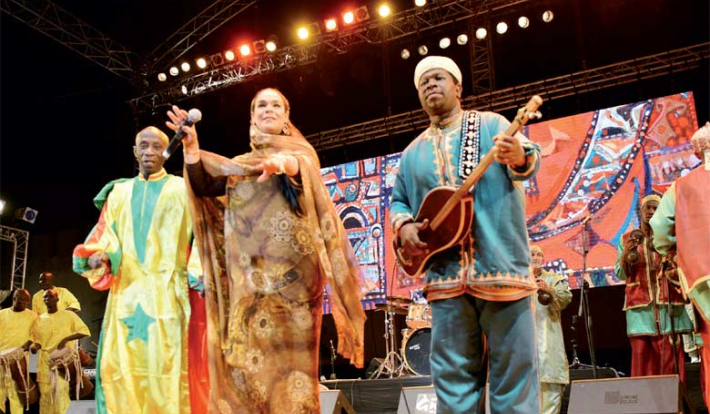
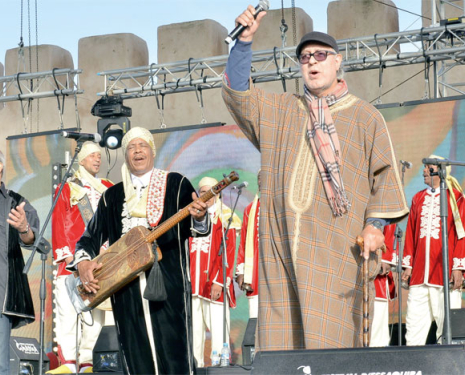
Colourful, moving, and unforgettable, the opening of the Gnaoua Festival of Essaouira, World Music, celebrated on 12 May, was simply exceptional. After the usual parade where musicians and Gnaoua troupes from Morocco mingled with a crowd amazed by this giant carnival, the public danced to the rhythms of the masters: Mahmoud Guinea and Doudou N'diaye Rose.
In opening the 19th edition of the Gnaoua Festival of Essaouira, World Music, a vibrant posthumous tribute was paid to the undisputed master of the guembri, Mahmoud Guinea, and to the Senegalese drum magician, Doudou N’diaye Rose. Their souls hovered over the Moulay Hassan square in Essaouira thanks to a residency of their children and family in communion. The public could not resist the sounds of Senegalese drums mixed with the notes of Gnaoua instruments. Endowed with great precision and a rare talent, the heirs of the two artists transported the Souiri, Moroccan, and foreign spectators into a purely African musical universe. According to Neïla Tazi, founder and producer of the festival, "the Gnaoua Festival of Essaouira, World Music, wants to mark the African anchoring of Morocco through the sub-Saharan African heritage. Musicians come from all countries to this festival to lend themselves to fusion, to a new language of music." This opening was sublimated by a fusion halfway between the Gnaoua rhythm, the Hassani trance, and African madness. The deep voice of Rachida Talal mingled with the Gnaoua sonorities to transport the public from Morocco and the magic of its Sahara to Senegal. "It is very difficult to attend this festival without the master of the guembri, but this tribute to the late Maâlem Mahmoud Guinea consoled us," confides an enthusiast of the Gnaoua Festival of Essaouira and World Music.
Today, the musical meeting for the Gnaouas and by the Gnaouas is orphaned. Behind the scenes, a phrase often returned. "How can an edition of the festival take place without Maâlem Guinea?" Even after his death, the one who was the emblematic figure of the festival remains in hearts and his music is transmitted through his students and his children. A respected and feared Maâlem, Mahmoud Guinea himself implicitly gave his directives to pass the torch to a new generation just as talented. During the last edition of the Gnaoua Festival, he handed his guembri to his son Hamza as if to shout to the whole world that Mahmoud is dead, certainly, but that Guinea remains eternal… From generation to generation, Master Guinea had music in his blood, in his genes, carried by a passion and a family heritage.
Mahmoud Guinea has a Malian grandfather who arrived in Essaouira in 1927. Samba Guinea, whose surname combines music, dance, and the magic of Africa, was a corporal doctor at the time, who also treated psychological disorders with trance sessions once a week. A custom in which Mahmoud Guinea was immersed thanks to his grandfather and his father: Boubker. Moreover, Mahmoud attended "lilates" very young before holding his first guembri in his hands, which he would never let go of. A guembri specially made for him by the hands of his father, and which he would in turn make for his son Houssam and which he would hand over to him less than a year ago during that famous closing evening of the 18th edition of the festival… He knew how to make his heritage bear fruit and make it travel, to try it at something else. Avant-garde, he was not content with just animating the lilates, he went further.
In the 1970s, he was part of the Moroccan folk group "Lamchaheb" and defended a "Nayda" movement where music is committed. He is one of the precursors in terms of fusions with jazzmen; he recorded an album with saxophonist Pharoah Sanders in 1991 entitled "The Trance of Seven Colors". From then on, and thanks to the Gnaoua Festival, the great Guinea became international and made his music travel to Japan, the United States, the Middle East, and Europe. He shared the stage with the greatest without ever trembling, without ever being impressed.