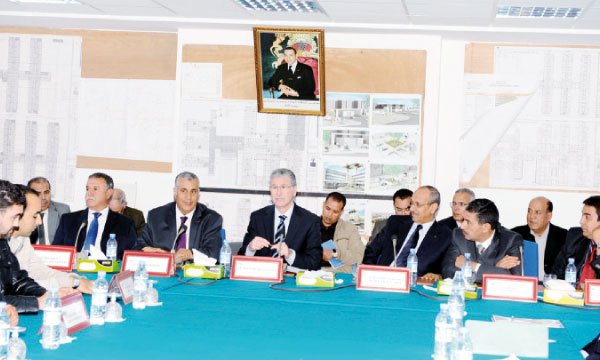
The Minister of Public Health, El Hossein El Ouardi, presided on Tuesday, 21 May, over the official signing ceremony of a partnership agreement for the implementation of an Emergency Medical Service (SAMU). In the presence of local authorities, he recalled the ultimate goal of strengthening the quality and speed of care and making the emergency service of the provincial hospital of El Jadida more efficient.
He also indicated that this agreement, which is part of the government programme, is part of the national plan for managing medical emergencies in Morocco. It was presented during a solemn ceremony presided over by HM King Mohammed VI in Fes. He also declared that the main objective of his department is to restore the confidence of citizens. This is to be achieved through the application of concrete measures by implementing the provisions of the new Constitution relating to the right to health, the execution of a participatory policy, the application of the government programme in this area, and the strengthening and consolidation of achievements. The Minister of Health then stressed that this project, the first of its kind, is structured around the following main axes: improving the management of pre-hospital and hospital emergencies, strengthening the training and supervision of medical and paramedical staff, developing public/public and public/private partnerships, and promoting the regulatory framework in this area.
However, according to the Minister of Health, all the effort that will be made cannot succeed without a policy of training medical staff, announcing in this context that for the first time in Morocco, nurses specialised in emergency care will be trained. Regarding the strengthening of the training and supervision of medical and paramedical staff, the Minister of Health highlighted the importance of developing Emergency Care Training Centres, as well as the creation of a training path for ambulance technicians, a paramedical path in emergency care, and the establishment of an Expertise Centre for emergency evaluation. “Improving the management of hospital emergencies in the province involves, for its part, putting into service 20 ambulances, 20 doctors, 20 nurses, and 6 type A ambulances,” he stated. Charki Draiss, for his part, welcomed this initiative while praising its initiators. “It is our mission to ensure that we offer Moroccan citizens a medical service that meets the aspirations of His Majesty”.
The cost of any initiative for the benefit of the people matters little. The essential thing is to carry out social projects that fight against the distress of our underprivileged society,” he concluded. Finally, let us note that this project, with a total cost of 66 million dirhams over three years, is the subject of a partnership agreement between the provincial committee for human development (INDH), the Ministry of Health, the OCP Group, JLEC, the rural commune of Moulay Abdellah, the rural commune of Haouzia, and ISSAF Assistance.
SAMU Services
The SAMU allows for several missions to be carried out, including the reception and triage of ISAAF calls with a permanent listening line (24/7) through the number 2222 dedicated to the El Jadida SAMU; the coordination of the most appropriate rescue resources in the fastest time; the verification of the availability of hospital beds in order to direct patients immediately to the service best suited to their pathology; warning the receiving service to prepare for the patient's arrival; and the continuity of care during transport... The SAMU will also make it possible to offer staff better working conditions thanks to ambulances equipped with high-performance equipment. The El Jadida SAMU will intervene throughout the province for a total population of 635,000 inhabitants residing in the province as well as for people passing through. The El Jadida SAMU has a medical assistance and regulation platform with 5 medical bases (central base El Jadida, Sidi Smaîl, Ouled Frej, Bir Jdid, and Ouled Ghanem).