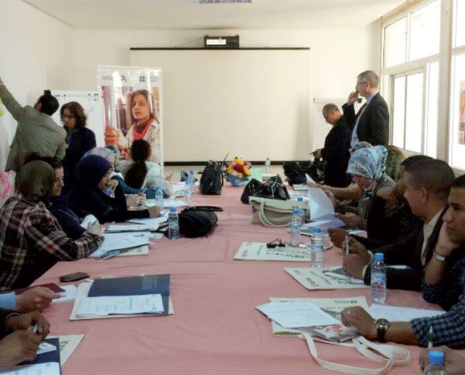
Under the aegis of the Ministry of Tourism, the Rural Tourism Development Network of Southern Morocco (RDTR), the Ibn Zohr University of Agadir, and the Atlas Kasbah ecolodge are organising an international conference-forum under the theme: "Tourism and climate change in Morocco and the Mediterranean region: a global challenge, local solutions" in Agadir on 8 and 9 June. Spread over two days, this meeting will include conferences and exchange forums between scientists, institutional actors, and tourism stakeholders.
This conference-forum is part of a local desire to develop the search for solutions at the very heart of the tourism and climate change issue. Indeed, current research has been able to highlight findings, but few concrete solutions have been able to be operationalised, notably because the perspective is too often global and not local. To this end, the Agadir conference-forum proposes to respond to this problem by providing practical and adaptable solution elements to different tourism contexts. Morocco is an interesting case study, given its great geographical diversity (coast, mountain, oasis, desert,...) and the vulnerability of its ecosystems.
The objectives of this conference-forum are therefore to understand, exchange, and act, because the tourism industry must continue to develop within the framework of a sustainable approach in a region as vulnerable as the Mediterranean, and notably in the Kingdom of Morocco. It will therefore be a question of identifying means of adaptation for destinations and tourism actors, or even solutions aimed at mitigating the impacts of tourism on climate change and of climate change on tourism. Complementarily, opportunities for exchanging ideas, good practices, and initiatives will be put to good use.
As a reminder, tourism is responsible for about 5% of global CO2 emissions, i.e., 4.6% of global warming. Of course, the transport sector is the most polluting since it constitutes 75% of GHG emissions attributable to tourism, and notably air traffic. The hotel sector, for its part, emits nearly 20% of the sector's emissions due to air conditioning, heating, maintenance... According to the World Tourism Organisation, the rise in traveller flows could increase GHG emissions by 150% over the next three decades. Consequently, it is necessary to act quickly via concrete measures such as, for example, the implementation of environmental management.
Since the launch of Vision 2010, the Moroccan Ministry of Tourism has also favoured hotel and tourism environmental management. Vision 2020 has accentuated this desire by placing sustainable development at the heart of this strategy. Despite the weak desire of Moroccan tourism and hotel companies to undertake this type of approach, the trend is towards change since the ministry has been able to highlight the savings made by the company in this framework and to advocate minimal and low-cost changes to begin the questioning process. In this context, it has therefore opted for environmental management and notably energy efficiency.
News 07 Jun 2012 3 min read
Tourism and climate change in Morocco and the Mediterranean region: A global challenge, local solutions