After four days of cinema, debates, meetings, and workshop work, the curtain fell on Saturday evening on the 9th edition of the Agadir Cinema and Migration Festival, which was chaired by the Moroccan novelist and poet Tahar Benjelloun.
One must really take one's hat off to the entire organisational team, led by Aziz El Omari, the festival director, and alongside him Driss Moubarik, the president of the Cultural Initiative Association, to whom we owe this artistic event dedicated to the 7th Art and devoted to the theme of migration. But this choice is not fortuitous because the festival is organised in the capital of Souss-Massa-Drâa, a region of emigration for a very long time.
Like every year, the programming focused on a range of feature films dealing with the theme of migration, by Moroccan, European, and other directors ("Illégal" by Olivier Massey-Depasse, "Beur sur la ville" by Djamel Bensalah, "Andalousie mon amour" by Mohamed Nadif, "Nuovo mondo" by Emanuel Crialese, "Notre étrangère" by Sarah Bouyain, "La route de Kaboul" by Brahim Chkiri, "De l'huile sur le feu" by Nicolas Benamou); short films ("Sur la route du paradis" by Uda Benyamina, "6h 15 mn" by Mouna Karimi, "Au secours Africa" by Zaynab Toubali, "Inchallah" by Abdelhadi El Fakir, "Hamman, sa femme et le couscous" by Fettah Diouri, "Mariage mixte" by Salma Ed-Dlimi, "Rocky doit mourir" by Abdellah Nihrane, "Ensemble" by Mohamed Fekrane, "Le temps des miracles" by Lahoucine Chkiri, "Le suicidé" by Youssef Fadel, "Chlamydia" by Ben Younes Bahkani, "Astaghfiro" by Adil El Arabi), and documentaries ("Rosans, miel amer" by Rémi Nelson Borel, "Bruxelles-Kenya" by Zakria Bakkali, "Partir, retourner. En voyage" by Francesco Conversano Nene Grignaffini, "Afric Hotel" by Hassen Ferhani and Nabil Djedouani, "Gaza" by Hassan Rahali.
As part of the travelling cinema, and in partnership with the general directorate of prison establishments, a series of screenings took place at the local prison of Aït Melloul with the programme: "Ali, Rabiâa et les autres" by Ahmed Boulane and "La symphonie marocaine" by Kamal Kamal.
And as usual, in collaboration with the Cultural Initiative Association, the Touche pas à mon enfant (TPAME) Association was present on Saturday 11 February 2012 for an awareness-raising operation for the festival public regarding this true scourge that represents abuse and mistreatment against children. This year, the association chose to convey its message through the screening of the film "La danse du monstre" directed by Majid Lahcen with Hassan Benjelloun as artistic director and produced by Abdellah Dari. The film's screenplay was written by Amale Temmar, a very active member of Touche pas à mon enfant, who is also the main actress alongside Abdallah Chakiri, Fatima Aatif, and Aziz Dhiouer.
Since the first edition of the festival, Ibn Zohr University of Agadir has always been present. Notably, and at each edition, a special programme dedicated to students of the relevant courses, concocted by the festival team in consultation with the professors and officials of the latter.
The Faculty of Letters and Human Sciences hosted the following workshops this year: "Meeting with a professional actor: journey and dramatic interpretation" led by Rabie Kati; "Meeting with an actor-director: On the menu, the three writings", directed by Mohamed Nadif; "Grammar of the image and media education" directed by El Houcine Oilil.
In addition to the aforementioned workshops, a series of short film screenings followed by debates with students in the presence of the directors took place at the cultural space of the Faculty of Letters ("Fautes volontaires" and "La tache" by Abdelillah Zirat; "Ma poubelle géante" and "Sur la route du paradis" by Uda Benyamina; "Mawal", "Balcon Atlantico" and "Le temps des camarades" by Mohamed Chrif Tribak).
Obviously, Tahar Benjelloun could not come to the festival without dedicating some of his time to the University. He therefore went to meet the professors and students of the Faculty of Letters where a debate on the migration issue took place with the students of the Master's in "Migration and Sustainable Development". At the end of the screening of the documentary "Partir, retourner. En voyage" based on a story by Tahar Benjelloun.
A space for debate on the migration issue, the festival offered the Agadir public four conferences at the Chamber of Commerce: "The demographic background of the Arab revolutions: What possible effects on migration?" moderator: Youssef Courbage (Syria); "Migration and diasporas: Comparing Morocco and Mexico, their policies and practices", moderator: Jean-Baptiste Meyer (France); "Minor migrants: Between state logic and particular logic", moderator: Houria Alami Mchichi (Morocco); "Women in migration: A plural reality?": moderators: Karia Mckanders (USA), Mehdi Lahlou (Morocco), Mohamed Charef (Morocco), Houria Alami Mchichi (Morocco). It is, moreover, Mohamed Charef, the director of ORMES, who is in charge of this programme.
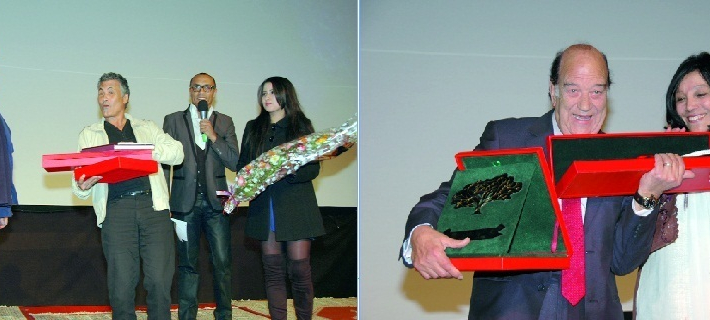
And as expected, the highlight of this 9th edition of the festival was the tribute paid to two great names of Moroccan and Egyptian cinema: Younès Megri and Hassan Hosni.
Finally, it should be noted that some very bad news had circulated during the festival according to which the Rialto was going to close its doors permanently just after it, and this for purely material reasons, the cinema no longer making a profit for years already. But during the closing ceremony which took place in the presence of the Minister Delegate to the Prime Minister in charge of the Moroccan Community Abroad, the Minister of Handicrafts, the Wali of the Souss-Massa-Drâa region, the President of the Regional Council, and several personalities as well as numerous actors, directors, producers, among others, one of the owners of the cinema went to the podium and announced to the audience that after the intervention of the Wali, they had decided not to close the cinema, which would continue to fulfil its cultural and artistic mission. And it was therefore standing that the whole room had welcomed this decision in a thunder of applause.
Everyone therefore made an appointment for next year for the 10th edition at the Rialto cinema.
Festival 14 Feb 2012 5 min read
Cinema and Migration Festival: A successful edition with few resources